
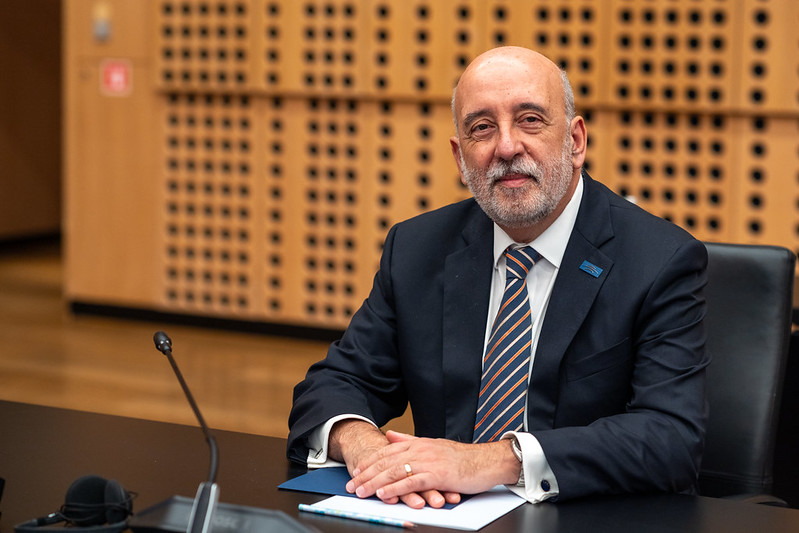
By David Barwick – FRANKFURT (Econostream) – Fragmentation rather than insufficient bank capital is the main obstacle to a more effective European banking sector, European Central Bank Governing Council member Gabriel Makhlouf said Thursday, calling for completion of Banking Union and removal of barriers to cross-border activity.
Makhlouf, who heads the Central Bank of Ireland, told the Eurofi Financial Forum gala dinner in Dublin that Europe needed an integrated financial system capable of operating at European rather than national scale while retaining the resilience built since the financial crisis.
On bank capital, Makhlouf said, “I am not convinced that the level of capital is part of the problem,” adding that available evidence did not support that conclusion.
Instead, he identified divergent insolvency regimes, inconsistent implementation, fragmented digital infrastructure and differing employment rules as more important impediments to cross-border banking, and said financial regulation alone could not overcome an incomplete Single Market.
Completing Banking Union would require a European Deposit Insurance Scheme, Makhlouf said, arguing that national safety nets continued to inhibit genuinely European banking and the efficient use of capital and liquidity within cross-border groups.
While supporting simplification of regulation and supervision, Makhlouf warned against changes driven by short-term considerations or aimed at reducing financial-system resilience, and opposed giving supervisors a mandate to weigh competitiveness against their existing responsibilities.
Greater clarity, common methodologies and a better understanding of how different capital requirements interact would nevertheless improve the framework, he said, noting that layered requirements could make buffers harder to use when needed.
Turning to capital markets, Makhlouf said Europe’s problem was not an overall shortage of savings but its ability to channel those savings toward productive investment, pointing to roughly €10 trillion in European cash deposits against estimated additional investment needs of €750 billion to €800 billion annually by 2030.
“A genuine single capital market ultimately requires a single safe asset,” he said, while stressing that the decision on such an asset was for political authorities rather than central bankers or regulators.
The Savings and Investments Union and Banking Union reforms were necessary but insufficient without stronger real-economy performance and a more complete Single Market in goods, services and capital, according to Makhlouf.
On payments, Makhlouf backed preserving the two-tier monetary system of central-bank and commercial-bank money while adapting it to a digital and tokenized economy, and said the Eurosystem’s work on new settlement technologies and the digital euro was intended to keep public money at the center of that system.
More broadly, he argued that Europe should respond to geopolitical fragmentation and competitive pressure by completing integration rather than weakening post-crisis safeguards, saying stronger productivity and competitiveness depended on a deeper, more integrated and resilient European market.
- The author of this story can be contacted at david.barwick@econostream-media.com