
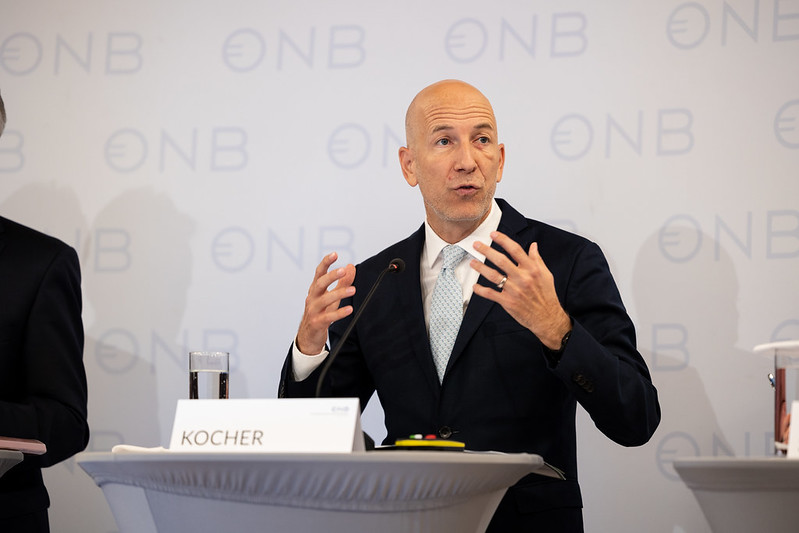
By David Barwick – FRANKFURT (Econostream) – A further European Central Bank interest rate increase will be needed soon if updated projections confirm the inflation outlook suggested by recent data, ECB Governing Council member Martin Kocher said Tuesday.
“We will receive the new projections in the next few days. If they confirm what can currently be expected and what we have known since July, then I believe a rate increase will be needed soon, from my point of view,” Kocher, who heads the Austrian National Bank, told Austrian broadcaster Ö1.
The ECB would first have to analyse the new data before taking its decision next Thursday, Kocher said, but inflation pressure had remained too high for too long.
“The fact is that inflation pressure has remained high for longer than we would like,” he said. “Our target is an inflation rate of 2% over the medium term.”
Asked about the size of a possible increase, Kocher said it was too early to decide, while noting that ECB rate moves were normally made in quarter-point increments.
“As a rule, we talk about interest rate steps of a quarter of a percentage point,” he said. “In June, we raised the relevant policy rate to 2.25%, and in the period ahead the discussion is about another rate step.”
The ECB was determined to do whatever was necessary to keep inflation under control, Kocher said, while warning against complacency even though policymakers were handling the current inflation episode better than the surge of 2022 and 2023.
“We are managing that better in this phase than we did back in 2022 and 2023, but it is important that we do not become complacent and that we work very clearly toward bringing inflation back into the target range,” he said.
Kocher attributed the latest inflation pressure in large part to energy, noting that energy prices had risen again in recent weeks. Austrian inflation reached 3.2% in August, while euro area inflation was also above the ECB’s 2% target, he said.
“These are exogenous factors that cannot be directly influenced,” he said. “The right response is the right monetary policy, in order to bring inflation back to the 2% target over the medium term. And the ECB is firmly determined to do that.”
Higher interest rates inevitably weighed on economic activity, Kocher acknowledged, making the balance between growth and inflation part of the Governing Council’s policy calculation.
“Higher interest rates are always a drag on economic activity, and weighing the effects on economic development against the need to combat inflation is a judgment that the ECB Governing Council has to make,” he said.
But recent economic indicators had been more encouraging than expected, he said.
“Fortunately, however, we have signals showing that economic developments in Europe are somewhat more resilient than they appeared a few weeks or months ago,” Kocher said.
Industrial orders were showing “a certain amount of momentum,” while other indicators had also improved, although the high degree of uncertainty meant the developments could not be taken for granted, he said.
Kocher was hesitant to describe the economic improvement as an industrial upswing.
“Calling it an upswing would, I think, be very optimistic,” he said.
Economic conditions had nevertheless become somewhat more stable, he said, particularly in Germany, which was especially important for Austria, while industrial orders in many areas were looking better than only a short time ago.
“But what we are seeing so far is not a sustained, prolonged upswing,” Kocher said, adding that uncertainty remained very high and the global economy fragile.
Europe and smaller economies were particularly exposed to geopolitical uncertainty, he said, while Europe’s underlying growth potential was weaker than that of the United States, where artificial intelligence was creating additional growth potential.