
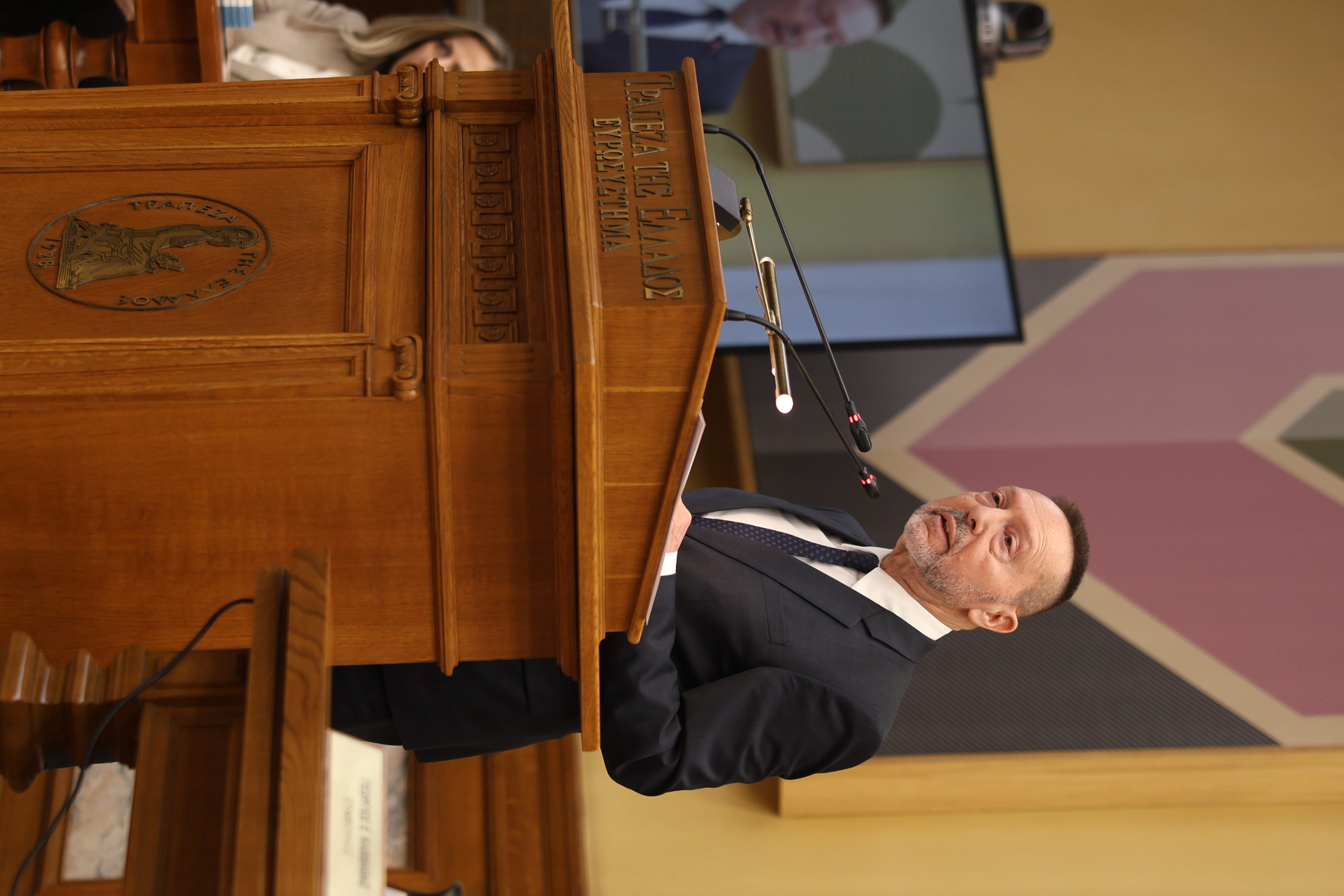
By David Barwick – FRANKFURT (Econostream) – European Central Bank Governing Council member Yannis Stournaras said Tuesday that renewed hostilities in the Middle East had created fresh uncertainty over inflation and economic growth after energy prices had briefly de-escalated.
Stournaras, who heads the Bank of Greece, said in a speech to the Hellenic Bank Association that the escalation of tensions in the Middle East and the disruption of energy flows due to the closure of the Strait of Hormuz had caused a sharp rise in energy prices.
The shock was “weighing on economic growth prospects and rekindling inflationary pressures globally,” he said.
More recently, the agreement between the United States and Iran had raised expectations of an end to hostilities and caused a significant de-escalation in energy prices, he said.
As a result, Eurozone HICP inflation fell to an “unexpected” 2.8% in June from 3.2% in May, a development that “could lead to a more favorable macroeconomic outlook than the spring 2026 estimates,” Stournaras said.
“However, hostilities have resumed, and are continuing, resulting in a significant increase in oil prices again and a new cycle of uncertainty around inflation and the rate of economic growth,” he said.
The Eurozone economy had been resilient over the past year despite significant trade tensions, he said.
However, the deterioration of the geopolitical environment and the renewed energy crisis were expected to “weigh on the near-term growth outlook for 2026,” as the Eurozone remained a net energy importer, he said.
Higher international energy prices, combined with increased uncertainty, were hurting consumer and business confidence, dampening domestic demand and reinforcing inflationary pressures, Stournaras said.
Eurozone real GDP fell 0.2% on the quarter in 1Q26, after rising 0.2% in 4Q25, he said. Eurosystem staff projections from June saw Eurozone growth at 0.8% in 2026, 1.2% in 2027 and 1.5% in 2029, he said.
Stournaras said Eurozone inflation remained above the ECB’s 2% target after having declined to 2.8% in June from 3.2% in May and 1.9% in February.
The Greek economy was expected to keep growing faster than the Eurozone average, with Bank of Greece forecasts putting GDP growth at 1.9% in 2026 and 2027 and 2.0% in 2028, he said.
Greek inflation was expected at 3.8% in 2026, up from 2.9% in 2025, before declining to 2.6% in 2027 and 2.3% in 2028 as energy and food price pressures gradually faded, he said.
Stournaras said the EU should speed up implementation of the Draghi and Letta reports, complete banking union and capital markets union, remove remaining barriers to cross-border transactions and create a common safe debt issuance mechanism modeled on the Recovery and Resilience Facility to finance public goods.