
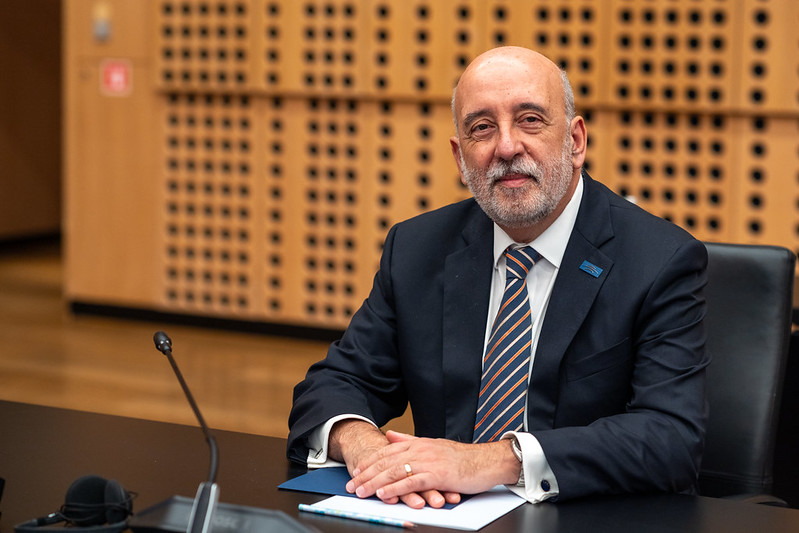
By David Barwick – FRANKFURT (Econostream) – European Central Bank (ECB) Governing Council member Gabriel Makhlouf said Irish fiscal policy should avoid adding to inflation pressures as euro area monetary policy had tightened and Ireland faced externally driven price pressures.
Makhlouf, who heads Ireland’s central bank, said in his annual pre-budget letter to Tánaiste and Minister for Finance Simon Harris that “[a] broadly neutral stance is appropriate” ahead of Budget 2027.
In the Eurozone, the ECB Governing Council had raised interest rates by 25bp to address inflation pressures, Makhlouf said. “The coherence of monetary and fiscal policy is essential for macroeconomic stability”, he said.
The Irish economy faced significant externally driven price pressures, while monetary policy was tightening, Makhlouf said. Fiscal policy should therefore avoid contributing to the build-up of inflation pressures, he said.
The global economy continued to face “challenges and heightened uncertainty” from the Middle East conflict and disruption in the Strait of Hormuz, Makhlouf said. Energy prices had surged and global supply chains had been disrupted, he said.
Modified domestic demand growth was projected to moderate, reflecting the dampening impact of higher energy prices on real incomes and consumption, Makhlouf said. However, multinational-led AI-related investment in Ireland would support growth over the forecast horizon, he said.
Inflation forecasts in the Central Bank of Ireland’s latest Quarterly Bulletin had been revised upward to 3.5% this year and 2.9% in 2027, with the energy-price outlook substantially higher than in the March Bulletin, he said.
Even with the recent US-Iran memorandum of understanding, uncertainty remained over when disruption to Strait of Hormuz shipping lanes would be fully alleviated and trade normalized, Makhlouf said. “Even in optimistic scenarios, inflation pressures persist”, he said.
Recent Irish economic performance also did not point to a need for fiscal stimulus to boost demand, Makhlouf said. The economy had grown rapidly since 2021, delivering sustained employment growth and low unemployment, he said.
Current cyclical conditions, including continued growth in domestic activity and near-term inflation above 2%, did not support expansionary fiscal policy, Makhlouf said.
Ireland’s small open economy and large international financial sector were operating in a particularly challenging context, Makhlouf said. The shifting geopolitical and trade landscape, as well as structural transitions related to climate, demography and technology, presented both opportunities and downside risks to growth and the financial system, he said.
Makhlouf warned that Ireland’s favorable headline budget position rested on “somewhat unstable foundations”, with the state’s revenue base now more reliant on corporation tax receipts than at any time in the past.
Corporation tax increases had driven 40% of all revenue growth since 2019, while the tax’s share of total general government revenue had risen to 23% from 12%, Makhlouf said. Around half of Ireland’s corporation tax receipts could not be explained by domestic economic developments and could be vulnerable to external shocks, the activities of a small number of companies and changes in international tax regimes, he said.
The tax base was also narrow, with 10 companies responsible for 56% of all corporation tax receipts in 2025, up from 41% in 2015, Makhlouf said. Two sectors, information and communication technology and pharmaceuticals, accounted for at least half of corporation tax revenue in 2025, he said.
Current government projections showed expenditure growth outpacing revenue growth in coming years, Makhlouf said. The underlying general government deficit, excluding estimated windfall corporation tax, was forecast to widen from €7.1 billion in 2025 to €20.4 billion in 2030, and could rise to €25.7 billion, or 5.8% of modified gross national income, known as GNI*, if expenditure overruns persisted, he said.
This would deplete fiscal buffers, limit the state’s ability to respond to future shocks and add to domestic inflation pressures, Makhlouf said.
The state’s borrowing costs were rising and interest expenditure was projected to double by 2030, Makhlouf said. Reducing public debt as a share of national income should remain a key focus of national economic policy, he said.
Government investment had doubled in nominal terms since 2019 and was projected to exceed 7% of GNI* in coming years, Makhlouf said. Addressing infrastructure deficits in a timely manner would help reduce inflation pressures over the medium term, he said.
Makhlouf called for a credible and binding domestic fiscal framework to reduce the risk of repeated boom-bust cycles. Ireland’s domestic fiscal framework needed to be strengthened because the discipline provided by EU rules was muted in an Irish context, partly because the rules were defined using GDP and did not account for windfall corporation tax revenue, he said.
Relatively favorable economic conditions and headline budgetary surpluses presented a window of opportunity to strengthen the fiscal framework, Makhlouf said. “But this window will not remain open indefinitely”, he said.