
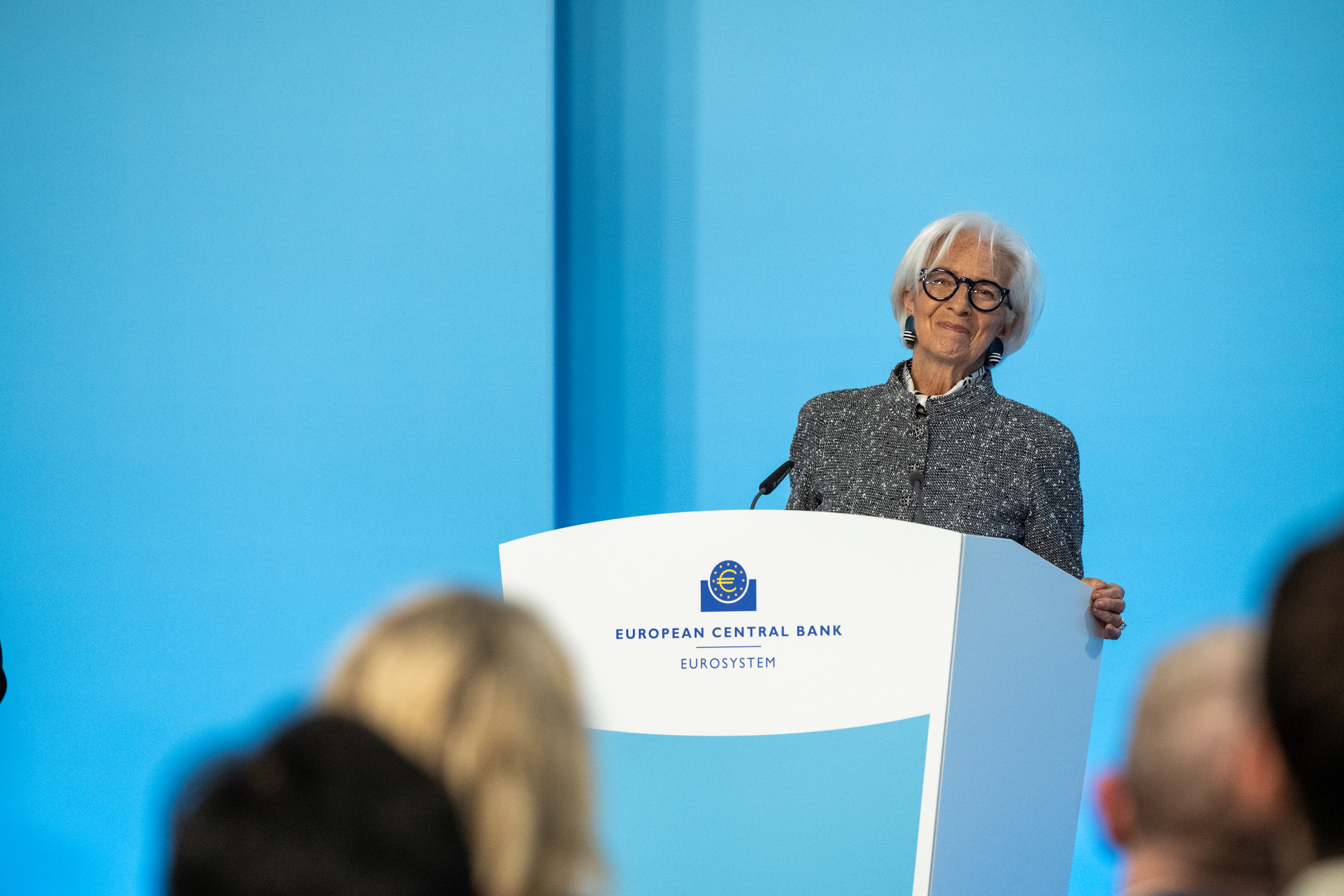
By David Barwick – FRANKFURT (Econostream) – European Central Bank President Christine Lagarde on Monday said the ECB’s June rate hike was warranted under all staff scenarios, while indicating that the current shock did not yet justify a forceful policy response.
In remarks prepared for a hearing of the European Parliament’s Committee on Economic and Monetary Affairs, Lagarde said the Governing Council had raised the ECB’s three key interest rates by 25bp in June to ensure that inflation stabilizes at the 2% target over the medium term.
“The decision to raise rates is robust across the scenarios prepared by staff, meaning that in all scenarios a rate hike is warranted,” she said.
Recent developments had remained within the range of scenarios considered by staff, Lagarde said. The ECB remained “well positioned to navigate the uncertainty caused by the war,” she said.
The ECB would continue to proceed on a data-dependent, meeting-by-meeting basis and was not pre-committing to any rate path, she said.
Rate decisions would depend on the inflation outlook and surrounding risks, incoming economic and financial data, underlying inflation and the strength of monetary policy transmission, Lagarde said.
Lagarde said the Middle East war was weighing on economic activity, with incoming data pointing to a slowdown, especially in services, while manufacturing had held up so far.
Domestic demand was now expected to be weaker than projected in March because the war had hit confidence and higher energy costs were weighing on real incomes, she said.
At the same time, household balance sheets remained sound overall, consumption should remain the main driver of growth, and investment should be supported by spending on digital technologies, defense and infrastructure, Lagarde said.
Inflation rose to 3.2% in May from 3.0% in April, driven mainly by energy inflation, which was above 10% in April and May, she said. Inflation excluding energy and food increased to 2.6% in May, partly reflecting initial indirect effects of higher energy prices, she noted.
Shorter-term inflation expectations had risen well above pre-war levels, Lagarde said. Longer-term expectations, however, remained around 2%, supporting the stabilization of inflation around target in the medium term.
The ECB was confident that inflation would return to target with appropriate monetary policy action, she said, citing staff projections that see headline inflation at 3.0% in 2026, 2.3% in 2027 and 2.0% in 2028.
Still, the outlook remained uncertain, with upside risks to inflation and downside risks to growth, Lagarde said. The Middle East peace agreement was welcome, but the situation remained fragile and subject to possible setbacks or re-escalation, she said.
The implications for medium-term inflation and growth would depend on the intensity and duration of the energy price shock and on indirect and second-round effects, she said.
Turning to the ECB’s monetary policy strategy, Lagarde said the 2025 strategy assessment had focused on how policy should respond to higher uncertainty and more frequent supply shocks.
The ECB’s approach rested on assessing the size, persistence and propagation of supply shocks, looking beyond the baseline to surrounding risks, and tailoring the policy response in a graduated way, she said.
Monetary policy could not lower energy prices directly, Lagarde said. But it had to assess whether higher energy costs were spilling over into other prices and whether they risked triggering second-round effects through wages and price-setting.
At this stage, the current shock appeared smaller than the previous inflation episode and was taking place in a different context, she said. Inflation had been closer to target when the shock began, while monetary and fiscal policy were no longer highly accommodative.
This suggested pass-through could be more limited so far, though risks remained if the shock intensified or persisted, Lagarde said.
“But this does not mean we can be complacent,” she said. After the high-inflation period of 2022 and 2023, price and wage formation may be more sensitive to new shocks, she said.
Lagarde said small and temporary shocks could in principle be looked through, while sizeable but not-too-persistent overshoots warranted a measured policy adjustment.
Large and persistent deviations from target would require a forceful or persistent response to avoid self-reinforcing dynamics and the risk that inflation expectations become de-anchored, she said.
“This is the framework which guided the decision we took in June,” Lagarde said. “For now, we are in the second case.”
The current shock was too large to look through without jeopardizing the ECB’s target, she said.
However, there was “no evidence yet of de-anchoring of inflation expectations or second-round effects that would warrant a more forceful policy response at this stage,” Lagarde said.
A graduated approach required the ECB to remain agile, Lagarde said. By proceeding meeting by meeting and staying data-dependent, the ECB could adjust its response as the shock evolved and ensure that policy remained proportionate, she said.
Monetary policy could not fully offset the impact of supply shocks, Lagarde said. Strengthening structural resilience, especially in energy, would be essential to reduce the Eurozone’s vulnerability to external supply shocks, she said.