
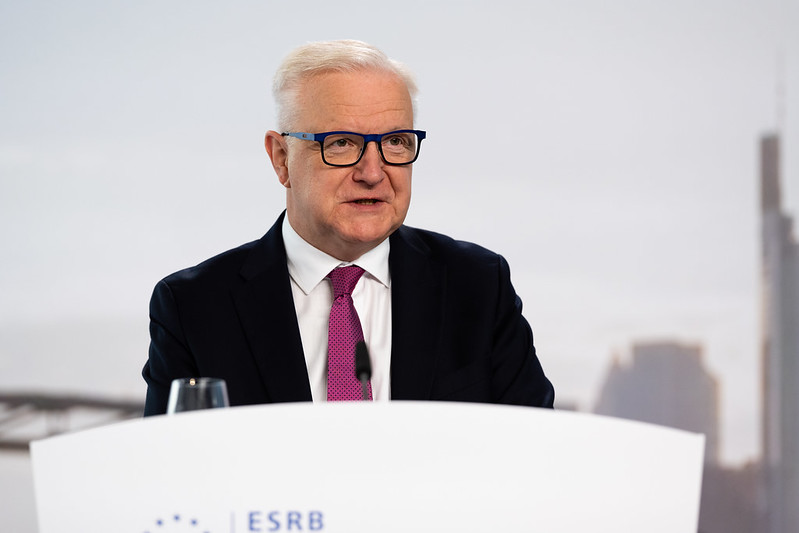
By David Barwick – FRANKFURT (Econostream) – European Central Bank Governing Council member Olli Rehn said Friday that the ECB’s June rate hike was aimed at keeping inflation expectations anchored and preventing price pressures from spreading from energy to other prices and wages.
Rehn, who heads the Bank of Finland, said in remarks at a press conference that the Middle East crisis was accelerating inflation and weakening the Eurozone growth outlook.
Against this background, the ECB Governing Council decided Thursday to raise its key interest rates by 25bp, he said.
“Since April, our understanding that the crisis and its effects are lasting longer has unfortunately strengthened, and indirect inflation effects on goods other than energy are already visible,” Rehn said.
Inflation had already accelerated clearly above the ECB’s medium-term target, while risks to inflation were mainly to the upside, he said.
“The rate hike supports keeping inflation expectations anchored in the current uncertain environment,” he said. “It also preemptively prevents price pressures from spreading from energy to other prices and wages.”
Rehn said he wanted to emphasize that the June rate hike was not due to the Governing Council assessing that inflation pressures had already become broad-based, spread to expectations and caused second-round effects in prices and wages.
Growth risks were clearly to the downside, he said. Financial conditions were tighter than before the Middle East war and could begin to restrain lending to firms and households, he said.
Lower labor-market tightness and firmly anchored medium- and long-term inflation expectations helped reduce the risk that fast inflation would persist and generate second-round effects, he said.
Earlier in his remarks, Rehn said several forward-looking indicators, including input prices, firms’ selling-price expectations and broader supply-chain disruptions, pointed to continued price pressures.
At the same time, domestic cost pressures in the Eurozone had continued to ease, and the energy shock had not yet been transmitted to wages, he said.
“On the contrary, wage agreements concluded even after the outbreak of the crisis indicate that wage growth will continue to slow,” he said.
Although inflation data contained the first signs of indirect effects from the crisis, there were "still no signs of worrying second-round effects, at least not yet," he said.
Rehn said the inflation impact of the Middle East crisis would ultimately depend on the duration and scale of the conflict and its pass-through, leaving the outlook exceptionally uncertain.
Current inflation expectations and forecasts were based on the assumption that the Middle East crisis would end this year and that the oil-market situation would gradually normalize, he said.
“Inflation risks are nevertheless to the upside,” he said. “If the crisis is prolonged, high inflation may continue longer than currently forecast.”
The Governing Council would continue to decide its monetary policy stance meeting by meeting, based on incoming data and an overall assessment, and was not pre-committed to any particular rate path, Rehn said.
The ECB would follow developments closely and was ready to act if needed to stabilize inflation at the 2% medium-term target, he said.