
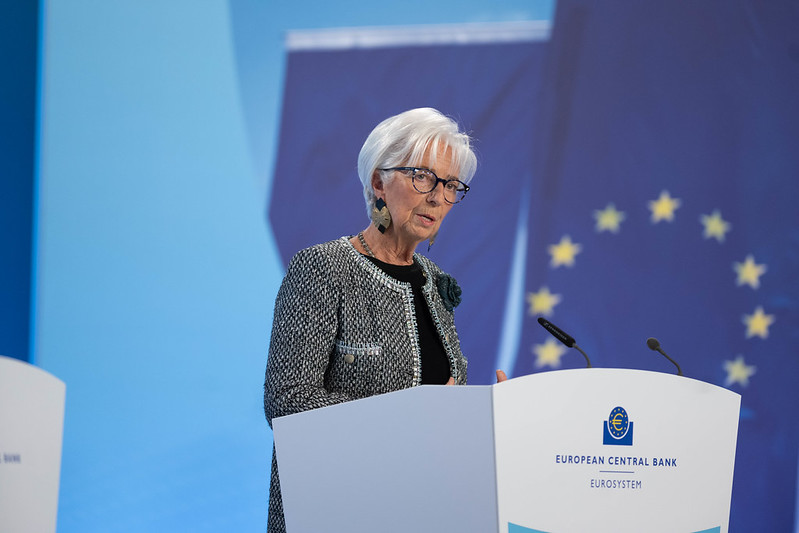
By David Barwick – FRANKFURT (Econostream) – European Central Bank President Christine Lagarde on Thursday warned that the environment facing central banks had become markedly more difficult, arguing that legal independence alone was no longer sufficient and that credibility earned through action would be decisive in preserving monetary autonomy.
Speaking in Phnom Penh at a meeting of Francophone central bank governors, Lagarde said the issue was no longer simply how to guarantee central bank independence, but “how to protect it when it is put to the test.”
“Today, these conditions are shifting, and a long-underestimated factor – the credibility earned through action – is becoming decisive,” she said. “It is precisely when monetary policy decisions are politically fraught and economically costly that credibility is most needed. And it is also when credibility is hardest to keep.”
Lagarde pointed to a world of more frequent supply shocks, tighter fiscal constraints and declining trust in public institutions, including central banks.
“Over the past decade, the de facto independence has deteriorated in almost half of central banks in countries that account for 75% of global GDP,” she said.
The ECB chief drew heavily on the Eurozone experience, arguing that the ECB’s authority had ultimately been built less through treaties than through crisis management.
“The treaties gave the ECB legal independence, but the crises gave it the authority it previously lacked to exercise that independence effectively,” she said.
Lagarde defended the ECB’s use of unconventional monetary policy tools during the sovereign debt crisis and subsequent years of very low inflation, saying the measures had been “strictly guided by a monetary policy logic” and remained within the ECB’s mandate despite legal challenges.
She also highlighted the ECB’s response to the post-pandemic inflation surge, noting that the Governing Council had tightened policy “at an unparalleled speed” in 2022 despite the political and economic difficulty of those decisions.
“These were not easy decisions,” she said. “But long-term inflation expectations remained anchored.”
Lagarde outlined what she called three essential conditions for maintaining central bank independence in a more demanding environment.
First, she said, central banks had to maintain clarity about their primary mandate of price stability and avoid subordinating it to secondary objectives.
“The Eurosystem supports the EU’s general economic policies – growth, employment and climate – but only insofar as they do not harm this primary objective,” she said. “When a central bank is seen to turn this hierarchy on its head, its independence suffers as a result.”
Second, she stressed the importance of direct communication with citizens and maintaining alignment between words and actions.
“This conviction gains democratic legitimacy through transparent decision-making methods and accountability to elected institutions,” she said. “It is in this space that credibility is earned - and also where it can be lost most quickly, when decisions and words no longer align.”
Third, Lagarde argued that preserving monetary policy room for maneuver depended both on fiscal responsibility and on maintaining financial-system resilience.
“When fragility in parts of the system … make each interest rate change potentially destabilising, the central bank sees its room for manoeuvre curtailed and financial stability considerations risk overshadowing price stability in practice,” she said.
Lagarde concluded by warning that the coming years were likely to intensify political pressure on central banks.
“In a world where conditions are getting harder, the challenge is no longer to simply maintain legal independence, but above all to maintain the credibility that is needed to exercise it,” she said.
“And the lesson of history is clear: it takes time to build trust, but only an instant to lose it.”