
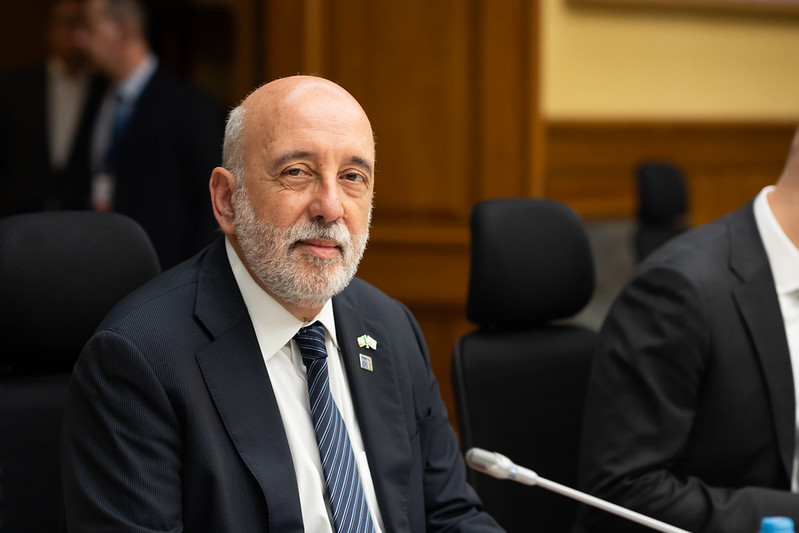
By Marta Vilar – DUBLIN (Econostream) – European Central Bank Governing Council member Gabriel Makhlouf said Wednesday that he had not yet seen clear second-round effects stemming from the Middle East conflict, though he added that did not mean such effects did not exist or could not emerge in time for the ECB’s June meeting.
Speaking at the launch of the Central Bank of Ireland’s first Financial Stability Review of 2026, Makhlouf, who heads the institution, said the source of external risks had shifted from global trade tensions in 2025 to concerns over the pricing and sustainability of global energy supplies following the outbreak of war in the Middle East.
“This shock, coming less than a year after the previous trade shock, and with no immediate sign of a resolution, increases the potential for tail systemic risks,” he said.
The global growth outlook had weakened while inflationary pressures had intensified, he said, adding that financial markets had so far continued to function in an orderly manner despite what he described as a disconnect between relatively contained market reactions and increasingly negative economic narratives surrounding the prolonged energy shock.
“This enhances the risk of a sudden tightening of global financial conditions, with a wider reappraisal of risk, amplifying any economic downturn,” he said.
During the Q&A session, Makhlouf noted that the ECB had already discussed the possibility of a rate hike at its April meeting.
He said indirect effects from the shock would likely persist even if the conflict ended immediately, adding that updated projections, colleagues’ views and his own analysis would shape his decision on the June 11 meeting.
“But certainly, the nature of the shock is one that has made our life more complicated,” he added.
Makhlouf declined to say whether the current environment was closer to the ECB’s baseline or adverse scenario, noting that he did not yet know what the information presented at the June meeting would indicate.
He said he was paying particular attention to indirect effects, especially the impact of higher energy prices on fertilizer and food costs, arguing that policymakers should look beyond oil and fuel prices alone.
Asked about market expectations for two or three rate hikes in 2026, Makhlouf said such pricing partly reflected confidence that the ECB remained committed to preserving price stability.
“My view is that markets making those assumptions indicates in part that they understand that we are determined to maintain price stability and we will take whatever action we need to achieve the 2% target,” he said.
The conflict had already lasted longer than policymakers initially expected, he added.
A peace agreement reached before the June meeting would be one factor to be considered for the ECB’s assessment, he said, though much would depend on the details and timing of any deal.
“At this stage I haven’t seen second-round effects, I have seen indirect effects,” he said, noting that second-round effects would emerge first in wage developments, while indirect effects had already become visible in food prices.
Makhlouf added that he expected second-round effects to appear with a lag.
However, he said that the absence of visible second-round effects so far did not mean they did not exist or could not be presented to the Governing Council at the June 11 meeting.