
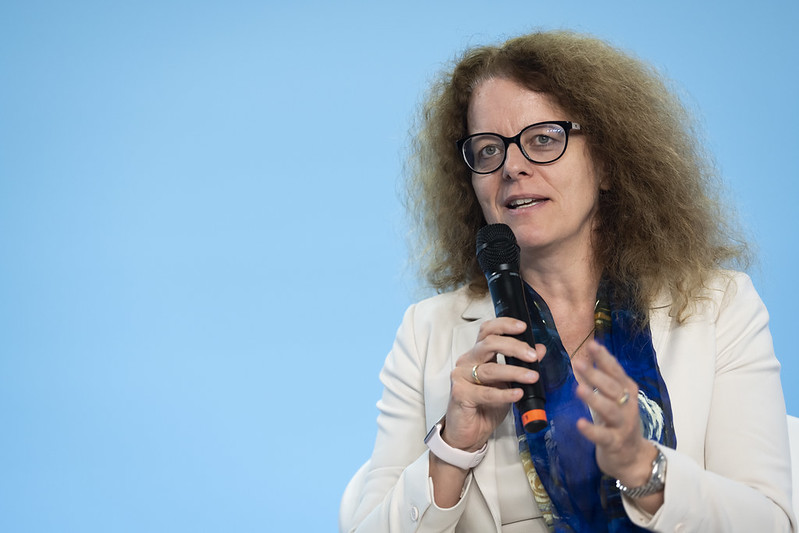
By David Barwick – FRANKFURT (Econostream) – European Central Bank Executive Board member Isabel Schnabel said Tuesday that the ECB would probably need to raise interest rates in June, arguing that the Middle East energy shock was now too large and persistent to be looked through.
The conflict had lasted longer than hoped, oil futures had moved above the ECB’s adverse scenario over longer horizons, and signs of spillovers to broader inflation were increasing, Schnabel told Reuters.
“Given the size and the persistence of the current shock, looking through is no longer an option in my view,” she said, according to the agency.
“From today’s perspective, I think a rate hike in June will be needed,” she said.
Schnabel said the relevant issue for policy was the size and persistence of the shock, which she described as “very large” by historical standards.
Oil prices were above the ECB’s March baseline assumptions, while both oil and gas were far higher than before the war, she said.
“Our hope that this conflict would be resolved quickly has not materialized,” Schnabel said. “The shock is much more persistent.”
In terms of persistence, the Eurozone had moved beyond the adverse scenario, which had assumed a rapid normalization of oil prices, she said.
Current prices were between the baseline and adverse scenarios, but the oil futures curve was above the adverse scenario at longer horizons, she said.
Schnabel said the main issue was whether the energy shock would feed through into broader inflation and generate indirect or second-round effects.
“We are seeing increasing signs that the shock is spilling over to other parts of the consumption basket,” she said.
Firms’ selling-price expectations had risen sharply across sectors, with the European Commission survey showing the share of companies planning price increases over the next three months rising faster than in 2022, Schnabel said.
PMI output-price data confirmed the signal, she said.
Short-term inflation expectations had also risen sharply across surveys and market indicators, Schnabel said.
The ECB’s Consumer Expectations Survey showed that medium-term expectations had increased as well, with the distribution shifting to the right, she said.
“This has often been interpreted as an early indicator that the risk of a de-anchoring of inflation expectations is increasing,” she said. “This must be monitored very carefully.”
Wages were harder to assess because negotiations were staggered and agreements often lasted a long time, Schnabel said.
“[I]f we wait for second-round effects to appear in hard data on wages, we will certainly be too late,” she said.
Forward-looking wage indicators, including the ECB wage tracker and surveys, were available, she said. Survey evidence showed a slight upward revision to wage growth, though it was too early to draw a firm conclusion, she said.
Schnabel said the ECB was facing an adverse supply shock, which created a policy dilemma because tighter monetary policy could be needed even though it would worsen the shock’s negative impact on the economy.
The shock was pushing inflation away from target over the monetary-policy horizon, she said.
Even an immediate end to the war would not remove the need for a policy response, Schnabel said.
“Even if the war ended today, a lot of damage has already been done to energy infrastructure and global supply chains,” she said. “So, even then, I believe that a monetary policy reaction would be needed.”
Schnabel declined to pre-commit to any rate path beyond June, saying the ECB would reassess the data at each meeting and decide whether another hike was appropriate.
“We will remain strictly data dependent,” she said.
The ECB’s March baseline had incorporated market expectations of two rate hikes, Schnabel said.
Asked whether markets were getting ahead of themselves, she said the ECB did not comment explicitly on market pricing.
“It’s us who steer the market,” she said. “It’s not the market steering us.”
A clear understanding of the ECB’s reaction function was important, Schnabel said.
She said it would be misleading to look only at headline inflation after an energy shock, because the projected path of headline inflation depended heavily on the shape of the oil futures curve and on base effects.
“What really matters for our inflation outlook is underlying inflation,” she said.
Schnabel said she saw significant upside risks to non-energy industrial goods inflation compared with the March projections.
Because the shock was global, pipeline pressures were rising worldwide, she said.
“I expect these higher costs to trickle through global supply chains, eventually showing up in higher goods prices,” she said.
The key monetary-policy question was whether weaker demand would be enough to bring inflation back to target over the medium term, Schnabel said.
The issue was whether firms would absorb higher costs in margins and whether workers would absorb the loss of purchasing power, she said.
“The policy reaction will depend very much on the extent to which the higher costs are being passed through to prices,” she said.
Incoming data suggested that the hit to growth would be stronger because the shock was proving persistent, Schnabel said.
Consumer confidence had fallen sharply, and consumption might prove weaker than projected in March, she said.
PMI data also showed a significant slowdown in services, while manufacturing was still expanding, possibly because of stockpiling ahead of shortages and higher prices, she said.
Investment prospects were more favorable, Schnabel said, because the shock had made investment in the green and digital transitions and in defense more urgent.
The global AI boom was also supporting global demand, she said.
Schnabel said the longer the war lasted, the greater the risk of physical shortages.
Europe had so far avoided shortages of refined products, fertilizers and petrochemicals, and concerns about jet fuel shortages appeared to have eased, she said.
However, oil inventories were being depleted rapidly, and future shortages could not be ruled out, she said.
The war was also disrupting global supply chains, Schnabel said, citing longer PMI delivery times, higher freight costs and a New York Fed indicator of global supply-chain pressure at its highest level since 2022.
“All of these imply downside risks to economic growth and upside risks to inflation,” she said.
The longer the war continued, the more those risks increased, Schnabel said.
Schnabel said the rise in Eurozone bond yields was mainly due to higher inflation compensation, partly reflecting higher inflation risk premia.
The best response from a central bank was to send a clear message that it would do what was needed to bring inflation back to target and then act accordingly, she said.
Markets could not tighten financing conditions in place of the ECB, Schnabel said.
“Markets reflect expectations about our policy, but they cannot do our job,” she said.
If market expectations were appropriate, the ECB would eventually have to act, she said. Otherwise, there would be a gap between the ECB’s actual reaction function and what markets believed it to be.
Longer-term inflation expectations were currently well anchored and the ECB’s credibility was not in question, Schnabel said.
“But this anchoring is conditional on us responding to an inflation surge in a proper way,” she said.
Schnabel said she was not concerned about fiscal support measures so far, given that they had been limited and fiscal constraints were becoming binding.
Governments should also keep fiscal policy sustainable, she said.
Asked about the Transmission Protection Instrument, Schnabel said she did not expect the tool to be needed, though it would be used if necessary and if its eligibility criteria were met.