
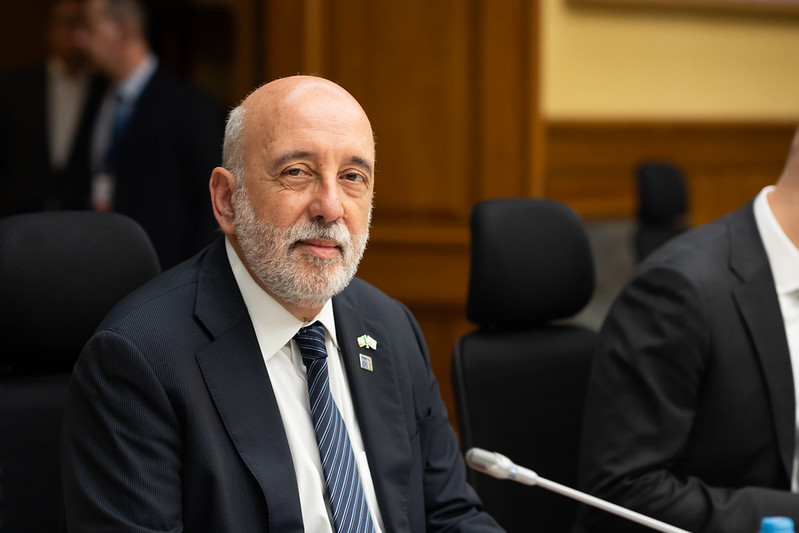
By David Barwick – FRANKFURT (Econostream) – European Central Bank Governing Council member Gabriel Makhlouf said in a speech that Europe’s Savings and Investments Union would not deliver the productivity gains the bloc needed unless the Single Market itself functioned properly across goods, services and capital.
Makhlouf, who heads the Central Bank of Ireland, said at the AFME European Financial Integration Conference that the Single Market had been one of Europe’s major political and economic successes, but that the European Union had defined its ambition too narrowly.
“A well-designed Savings and Investments Union (SIU) is important,” he said. “But the SIU alone will not deliver the productivity boost Europe requires if the Single Market it sits within is not working as it should.”
The Single Market had supported European growth and resilience for more than three decades, but its unfinished nature was costing Europe growth, resilience and opportunity, Makhlouf said.
European Commission estimates showed that the Single Market had already lifted EU gross domestic product by 3% to 4%, and that completing it could double those gains, he said.
The largest potential gains were in services, Makhlouf said. Services accounted for about 75% of EU GDP and the largest share of employment, but intra-EU services trade amounted to only 7.6% of GDP, no higher than Europe’s services trade with countries outside the bloc, he said.
Makhlouf said barriers in services were closely related to the obstacles fragmenting European capital markets, raising cross-border investment costs and preventing savings from flowing to their most productive use.
“The single market for capital cannot be separated from the single market for services,” he said.
The EU had a large financial system, with bank assets of around €33 trillion and debt securities of another €24 trillion, Makhlouf said.
However, EU stock market capitalization stood at 73% of GDP in 2024, about a quarter of the US equivalent, while EU venture capital investment in 2025 was around €66 billion, about one-fifth of the US level, he said.
The gap widened sharply for scale-up financing, where EU venture capital investment was below 10% of US levels, Makhlouf said.
Europe did not lack innovative start-ups, he said. “Rather, what it lacks is a deep capital market to grow them into large ones.”
Makhlouf said regulatory fragmentation was part of the problem, but more a symptom than the underlying cause.
The deeper problem was the absence of a genuine Single Market, especially in services, he said.
The SIU was welcome and necessary, but would remain constrained if the wider Single Market remained fragmented, Makhlouf said.
Completing Europe’s capital-market architecture required harmonized insolvency frameworks, more convergent tax treatment for cross-border investment and deeper post-trade settlement infrastructure, he said.
Makhlouf also called for a single European safe asset, saying this was a foundation for the SIU.
Without a common safe asset, pricing and collateral would remain fragmented and the development of a large European capital market would be hampered from the start, he said.
The NextGenerationEU program had shown that Europe could issue common bonds at scale and that markets would respond, Makhlouf said.
Outstanding NGEU debt was close to €800 billion, carried a AAA rating and had developed deeper secondary-market liquidity over time, he said.
However, NGEU bonds did not yet behave fully like safe assets, partly because the program was one-off and time-limited, he said.
“The question is whether this can be moved onto a more permanent basis, and not just crisis-linked and time-limited cases,” Makhlouf said.
A common safe asset would also support greater internationalization of the euro, building on recent changes to the ECB’s repo facility to make euro-denominated assets more attractive to global investors, he said.
Makhlouf acknowledged that deeper integration involved trade-offs, including potentially less national flexibility.
The relevant question was whether the cost of not acting now exceeded the cost of acting, he said.
The evidence was clear, Makhlouf said: Europe’s productivity gap with other economies such as the US was widening, and delay would make adjustment more expensive and Europe less competitive.
Makhlouf said Ireland illustrated the demand-side challenge facing European capital markets.
Ireland was a major financial hub, but household participation in capital markets remained among the lowest in Europe, he said.
Irish households held €172 billion in bank deposits as of March, with about 85% in overnight accounts earning little interest, while average household wealth was about €724,000 and heavily concentrated in housing, he said.
National barriers such as tax treatment, financial literacy and attitudes toward savings and investment had to be addressed alongside EU-level reforms, Makhlouf said.
“Europe cannot build a single capital market if its citizens are not active participants in it,” he said.
Makhlouf also said the Central Bank of Ireland supported supervisory convergence in Europe, but that this did not necessarily require more centralization.
Convergence could also come through stronger cooperation between national and European authorities, common standards applied consistently and a stronger shared supervisory culture, he said.
The Central Bank of Ireland was also pursuing regulatory simplification through a multi-year program aimed at making its framework more effective, clearer and more proportionate without weakening resilience, Makhlouf said.
“Simplification is not the enemy of robust regulation,” he said. “Done properly, it is what makes robust regulation credible and durable.”