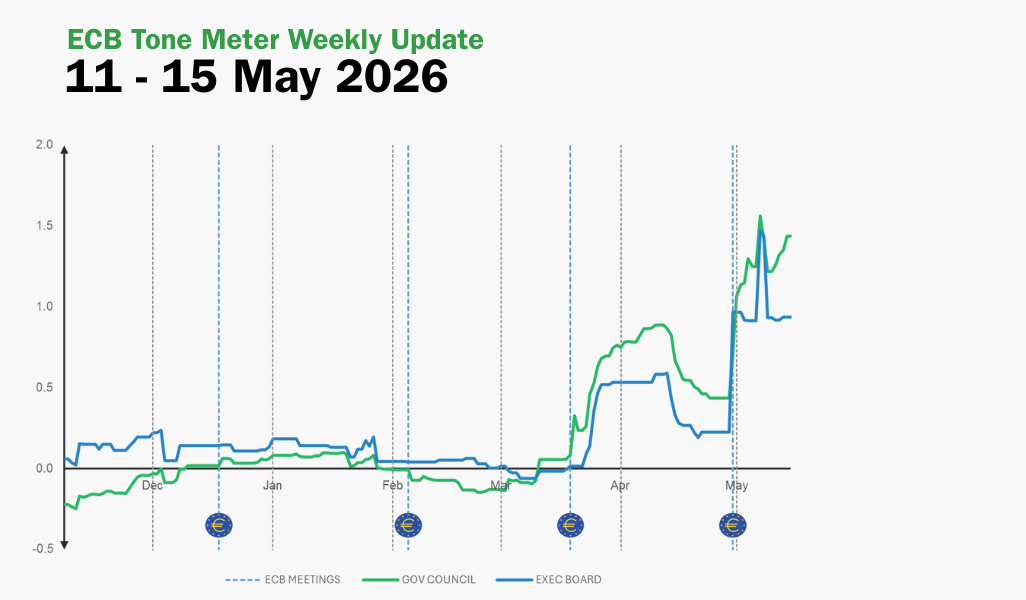
By Marta Vilar – MADRID (Econostream) – Econostream’s ECB Tone Meter fluctuated within slightly hawkish territory this week for the Governing Council, ultimately remaining broadly unchanged and ending just a touch more hawkish than last week, while the Executive Board edged more clearly lower but also stayed slightly hawkish.
The Governing Council index increased to +1.44 from +1.38 last week, while the Executive Board declined to +0.94 from +1.35 last week.
Policymakers still provide a conditional path to interest rate hikes, but they appear divided over what would trigger a move: a further deterioration in conditions, or simply the continuation of the current situation without improvement.
Biggest Movers of the Week: Lagarde, Lane, Kocher and Nagel
Lagarde sounded notably more cautious this week than she did at the ECB’s April 30 press conference, when she said she “directionally” knew where the ECB was heading and suggested the economy was moving away from the baseline scenario.
This time, she highlighted “massive uncertainty,” avoided repeating her earlier signal on the likely direction of interest rates, and said the economy now sits between the baseline and adverse scenarios. That points to a more static assessment than her most recent remarks had implied. This change in Lagarde’s tone was responsible for the sharp drop seen this week in the Executive Board and Governing Council indices.
Kocher also toned down his hawkish comments this week. In an interview with Econostream, he kept a June hike alive but said it was not his “baseline.” The Austrian central banker also suggested the current situation was closer to the baseline than the adverse scenario.
However, other Governing Council members came out this week for the first time since the April 30 meeting, before which they had sounded in favour of holding rates, but now put a hike back on the table.
That’s the case of Latvijas Banka Governor Mārtiņš Kazāks, who this week said that the ECB will be “forced” to hike rates if inflation expectations deteriorate, or Eesti Pank Governor Madis Müller, who said that a fast and positive solution in the Strait of Hormuz was necessary in order to avoid hikes.
Deutsche Bundesbank President Joachim Nagel struck a hawkish tone again, which was partly responsible for this week’s uptick in the Governing Council index. Nagel said hikes were to “become increasingly likely” if the inflation outlook does not improve significantly.
Dominant Themes in This Week’s Communication: Debate Over Conditions Leading to a Hike
This week policymakers appear divided over whether conditions would need to deteriorate further to trigger a rate hike, or whether simply maintaining the current situation without improvement would be enough to prompt a move — which would suggest that a hike is the baseline.
The divide was visible in how policymakers framed the threshold for action. Kocher explicitly denied that a hike in June was the default option, but said that “if things do not improve, if prices continue to be high or rise, it is difficult to keep interest rates at the level we have until the end of the year.”
For Nagel and Müller, the bar appeared relatively low: without a meaningful improvement in the inflation outlook or a swift resolution in Hormuz, further tightening remained a live risk. Kazāks set a higher threshold, suggesting that only a worsening in inflation expectations would “force” the ECB’s hand.