
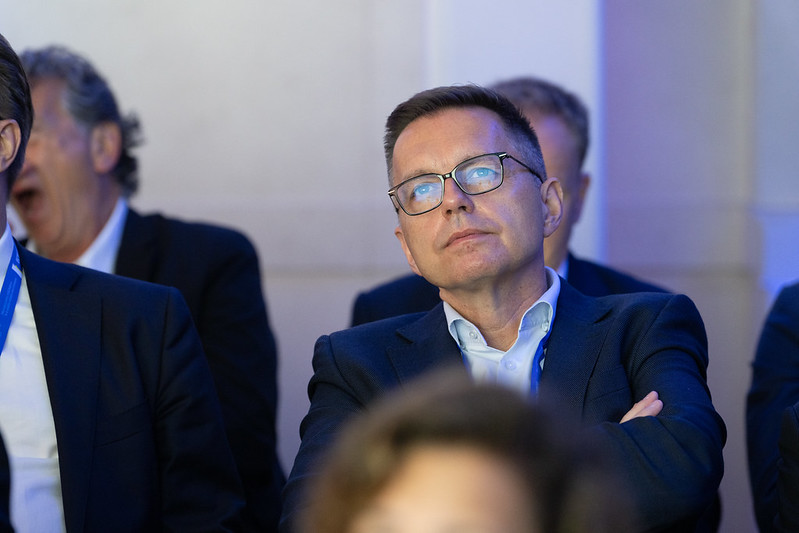
By David Barwick – FRANKFURT (Econostream) – European Central Bank Governing Council member Peter Kažimír said on Monday that policy tightening in June was “all but inevitable”, given that events since March had not surprised the ECB positively.
Kažimír, who heads Národná banka Slovenska, said in a blog post on the institution’s website that the ECB was not committed to any fixed path but remained firm in its approach.
“On this basis, policy tightening in June is all but inevitable,” he said. “It has been a part of our baseline since March and the events have, sadly, not surprised us in a positive way.”
The ECB decided last week to keep policy unchanged “for now”, because it needed more granular data to understand how current events were affecting the economy, he said.
Kažimír said the ECB had little ability to offset immediately inflation driven by large external supply shocks.
The rise in Eurozone inflation to 3% in April had been largely expected because of the energy shock, and further increases were likely in the near future, he said.
The ECB was charting the way forward in a world that had become more uncertain but “one-sided from a monetary policy perspective”, he said.
“We must understand the broader impact of higher energy prices,” Kažimír said. “They are bound to spread to the rest of the economy.”
Supply chains were likely to come under pressure again, making it necessary to understand how quickly this could happen and how large the effects could be, he said.
The ECB had to update its assessment of how far it had moved from its March baseline scenario, Kažimír said.
Financing conditions had already been tightening, which signaled that markets understood how the ECB thought and would react, he said.
Short-term inflation expectations had risen steeply, but movements in longer-term expectations had been small, according to Kažimír.
The memory of high inflation remained fresh, but so did the ECB’s success in guiding inflation back to target, meaning the central bank faced current challenges “from the position of stability,” he said.
Kažimír warned governments against poorly designed fiscal responses to the shock.
“Governments should ensure that fiscal responses are temporary and targeted,” he said. “Otherwise, it is better if they do nothing.”
The June forecast should show more about how far the ECB had moved from the March baseline, the types and magnitude of risks faced in a more adverse setting and the implications for monetary policy, he said.
The ECB was operating in a highly volatile and unpredictable environment, with the Middle East conflict continuing to weigh and energy prices remaining high and volatile, Kažimír said.
“It is becoming increasingly likely that we must prepare for a prolonged period of broad-based price increases coupled with visibly weaker growth across the Eurozone,” he said.