
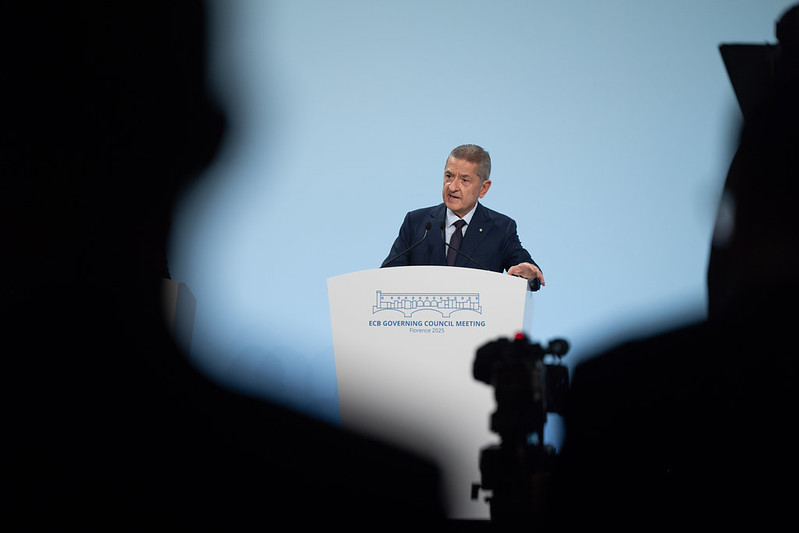
By Marta Vilar – MADRID (Econostream) – European Central Bank Governing Council member Fabio Panetta said on Tuesday that policymakers need to closely track inflation expectations and avoid second-round effects on wages, adding that monetary policy should remain “proportionate and aligned” with the ECB’s mandate.
In a speech at the Ordinary Meeting of Shareholders of the Banca d’Italia, which he heads, Panetta noted that the conflict involving Iran had nearly halted exports through the Strait of Hormuz and caused “significant damage” to energy production and refining infrastructure.
“Even in the event of a rapid ceasefire, a return to orderly conditions in the energy market would take some time,” he said.
According to Panetta, the surge in oil and gas prices was expected to dampen economic growth while pushing inflation higher. He added that elevated uncertainty was likely to persist even after the most intense phase of the conflict subsided.
While economic activity in 2025 had been showing resilience—supported by recovering investment and robust consumer spending—the Middle East conflict has “abruptly changed the outlook,” he said.
Financial markets had reacted with rising bond yields, falling equity prices, and a weaker euro, he said, adding that short-term expectations for inflation and interest rates had also increased, alongside renewed concerns about tighter credit conditions due to heightened uncertainty.
“Monetary policy is again facing a negative supply shock amid high uncertainty, as was the case in 2022, in the aftermath of Russia’s invasion of Ukraine,” he said.
Based on ECB projections, inflation was now expected to remain above target in 2026 before gradually easing in 2027, while economic growth was likely to be weaker than previously anticipated, he said.
“If the energy shock were to be stronger and more persistent than in the baseline scenario, inflation would rise further, while growth would be weaker,” he said.
Panetta highlighted risks of “significant” commodity price increases due to damage to energy infrastructure, as well as rising costs of intermediate goods stemming from potential disruptions to global supply chains—both of which could add further pressure on consumer prices.
“The magnitude of these effects will depend crucially on the pass-through of shocks to wages and on any resulting shifts in expectations, with the risk of a wage-price spiral,” he said.
Compared with the inflation surge in 2022, Panetta noted that monetary policy was now in a “more favorable position” to maintain price stability. Interest rates were closer to neutral levels, long-term inflation expectations remain anchored, the labor market had cooled, and banks were now highly profitable and had strong capital positions, he added.
Given this backdrop, the ECB had kept interest rates unchanged at its March meeting, he said, affirming that policymakers would remain data-dependent and follow a meeting-by-meeting approach, with a “firm” commitment to achieving 2% inflation over the medium term.
“In such an uncertain and ever-shifting environment, it will be essential to monitor expectations closely and to prevent a wage-price spiral, while ensuring that monetary policy action remains proportionate and consistent with the ECB’s mandate,” he said.
Related articles: