
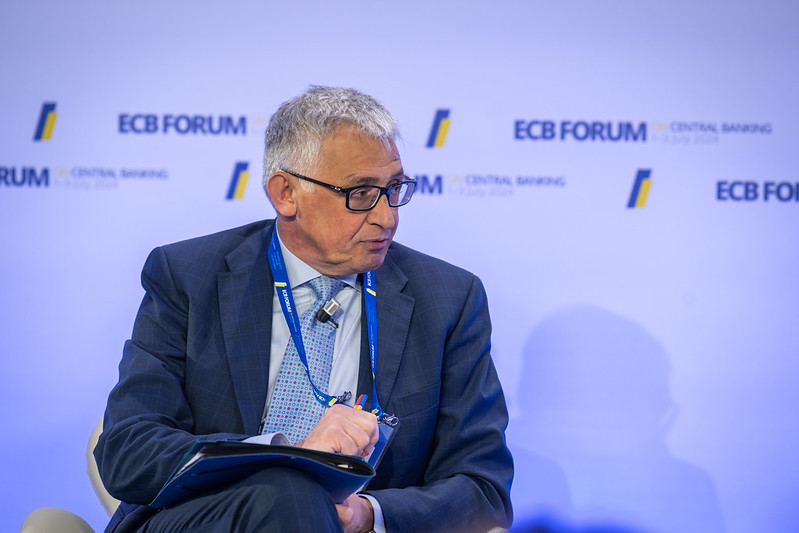
By David Barwick – FRANKFURT (Econostream) – European Central Bank Executive Board member Piero Cipollone on Thursday pressed the case for a digital euro, arguing that it would preserve access to public money as payments move online and reduce reliance on non-European payment providers.
Speaking in Rome to Italy’s Parliamentary Committee of Inquiry into the Banking, Financial and Insurance System, Cipollone cast the project as part of Europe’s push for greater resilience amid geopolitical tension and strategic uncertainty.
He said the central bank needed to ensure that “public money satisfies the evolving needs of Europeans,” describing the digital euro as a complement to cash rather than a replacement.
“This is not a side project – it forms part of the Eurosystem’s core tasks,” he said, framing issuance of a digital euro as an adaptation to changing technology and payment habits.
Cipollone warned that key parts of Europe’s payment infrastructure were increasingly owned and operated outside the euro area, creating vulnerabilities at a time when autonomy mattered more.
“A digital euro, built on European infrastructure, would allow Europe to regain ownership of the rails on which its payment system runs and thereby strengthen our autonomy,” he said.
For consumers, he said, the digital euro was intended to be usable across the euro area, free of charge for basic use, and available both online and offline, with offline payments offering privacy “comparable to cash.”
For merchants, Cipollone argued, a widely accepted European alternative could strengthen their hand against international card schemes that he said often involved high and non-transparent fees, while also supporting instant settlement and resilience when connectivity is disrupted.
Banks would remain central to distribution, he said, adding that holdings would be unremunerated and subject to limits to reduce the risk of large deposit outflows, and that technical work indicated day-to-day use would not undermine financial stability.
On the legislative track, Cipollone welcomed the Council of the European Union’s agreement on its negotiating position and said the European Parliament was expected to reach its position in May, while the central bank would “shortly” publish a call for interest for a pilot exercise.