
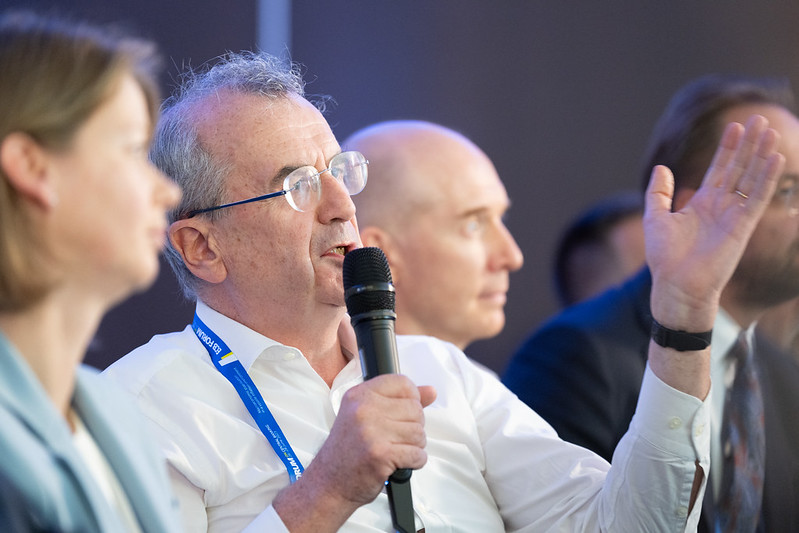
By David Barwick – FRANKFURT (Econostream) – European Central Bank (ECB) Governing Council member François Villeroy de Galhau on Wednesday argued that the ECB’s interest-rate stance was “well positioned” but should remain flexible, saying he was convinced with respect to inflation that “the downside risks are greater.”
Villeroy, who heads the Bank of France, made the remarks at a hearing before the French National Assembly’s Finance Committee and reiterated his intention to leave his post at the beginning of June to lead the Apprentis d’Auteuil Foundation.
With euro area inflation at 1.7% in January, he said that the Eurozone had “won the battle against inflation,” while noting that France’s harmonized reading of 0.4% was depressed by temporary factors.
Among those factors, he cited a 15% drop in electricity prices that took effect on February 1, 2025, as well as January sales lasting 18 days versus 13 a year earlier.
France’s inflation rate was not “too low,” he said, adding that it should gradually rise but remain limited, averaging just over 1% this year.
Lower inflation was broadly positive for France, he argued, supporting purchasing power and coinciding with wage moderation that he said would help competitiveness.
On monetary policy, Villeroy recalled that the ECB in early February unanimously decided to keep interest rates at 2% after eight cuts.
He compared the ECB’s key rate to the US and UK levels, which he put at 3.64% and 3.75%, respectively, and said policy “cannot and should not be static.”
The appropriate approach was “agile pragmatism,” he said, guided by data and forecasts.
Forex developments were one area of concern, he said, stressing that while the ECB has no exchange rate target, currency moves matter for the inflation and economic outlook.
The current configuration reflected dollar weakness more than euro strength, he argued, while pointing to what he called “inconsistencies and unpredictability” in US economic policy and saying markets had reason to be less confident in dollar-denominated assets.
Villeroy also flagged Chinese trade dynamics as potentially disinflationary, saying euro-area imports from China rose by more than 11% in volume in the last six months of 2025 from a year earlier while prices fell by more than 10%.
Even so, he downplayed monetary policy as the core policy challenge, saying, “today, monetary policy is not, or is no longer, the essential issue of economic policy.”
French activity remained “resilient” but insufficient, he said, citing 2025 growth of 0.9% and projecting 2026 growth of at least 1% alongside first-quarter growth of 0.2% to 0.3%.
The employment rate for those aged 15-64 was near 70% and not falling, he said, while noting the unemployment rate rose to 7.9% in the fourth quarter and that the increase was concentrated among 15-24 year-olds.
At the European level, Villeroy said potential growth had roughly halved over a generation and called for a new “leap of sovereignty” that was economic and financial, not monetary.
He argued against fiscal stimulus, urged a credible and predictable return to the 3% deficit threshold by 2029, and called for faster progress on simplification, a “28th regime” by 2028, and the Savings and Investment Union.
On payments, he urged Europe to innovate around tokenization and said 2026 would see “the first central bank digital currency,” while arguing that the digital euro should be combined with private payment schemes such as Wero or EPI.
According to some media present, Villeroy commented on speculation about a potential resignation of her post by ECB President Christine Lagarde. “I read a rumour about Lagarde, I discovered it, it doesn't seem an information to me, I'll leave it to the ECB to comment, but it's a rumor,” he reportedly said.