
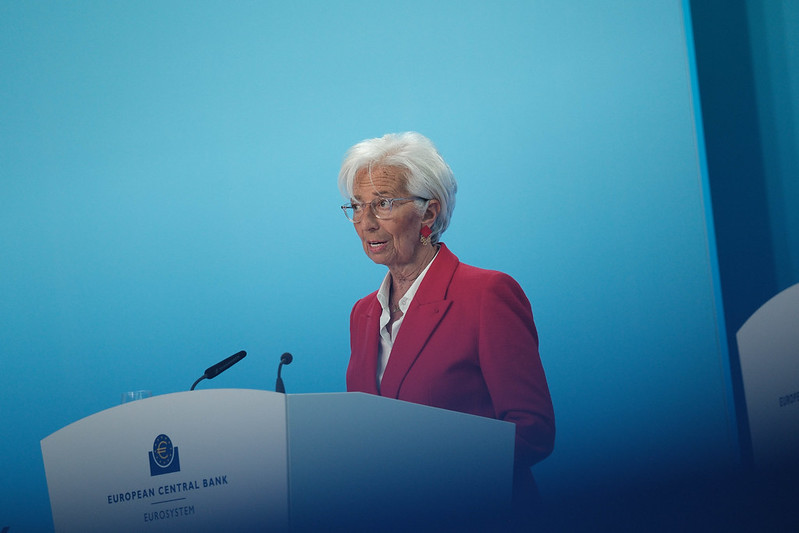
By David Barwick – FRANKFURT (Econostream) – European Central Bank (ECB) President Christine Lagarde on Saturday said trade and supply-chain dependencies had become a security issue for Europe, arguing that a more volatile geoeconomic environment would likely bring more frequent episodes of financial market stress.
Speaking at the Munich Security Conference, Lagarde said interdependence that was once viewed as a stabilizing force was now a vulnerability, citing both global disruptions such as the pandemic and the “weaponization of dependencies.”
Eurosystem staff were mapping products that are hard to diversify and difficult to substitute, she said, adding that the central bank could stress test the effects of abrupt supply disruptions.
Lagarde said ECB analysis suggested that a sudden 50% drop in supplies from “geopolitically distant” suppliers would cut manufacturing value added by 2%-3%, with the hit concentrated in electrical equipment, chemicals, and electronics.
She said Europe, as the most open of the major economies, needed to make the transition to strategic autonomy, but warned that competing concepts—such as reshoring and friendshoring—often blurred into different strategies that could work at cross purposes.
Lagarde grouped the policy choices into three approaches: independence by rebuilding critical supply chains at home, indispensability by strengthening Europe’s position in key nodes, and diversification across partners to avoid single points of failure.
Pursuing independence in sectors where Europe was far behind risked high costs that would erode downstream competitiveness, she warned, citing chipmaking as an example and cautioning against what she called “hollow champions.”
At the same time, she argued that relying solely on trade even within alliances carried risks because “[T]rusted partners do not always remain so,” and she said some domestic capacity would need to be built even if it was initially more expensive.
As an illustration, Lagarde said the United States conducted 114 orbital launches in 2023, compared with three for Europe.
“Broad-brush strategies” would not work, she said, urging a targeted approach that assessed strengths, weaknesses, and chokepoints at a granular level and weighed costs against benefits.
From the ECB’s perspective, she said policymakers had to be prepared for more volatility as industrial policy became more assertive, geopolitical tensions rose, and supply chains were disrupted.
Lagarde said the ECB needed to avoid a scenario in which market stress triggered fire sales of euro-denominated securities in global funding markets, undermining the transmission of monetary policy.
To support confidence among partners that transact in euros, she said, the Governing Council last week decided to expand the EUREP facility, which she described as a standing tool that provides euro liquidity against high-quality collateral.
Lagarde said the changes would give the facility permanence by providing continuous access rather than temporary lines, broaden its reach from a regional to a global perimeter, and improve agility by granting access by default unless there was a reason to restrict it.
The availability of a lender-of-last-resort-style liquidity backstop for central banks would reinforce the euro’s role by supporting confidence to invest, borrow, and trade in euros during disruptions, she said.
“In a world where supply chain dependencies have become security vulnerabilities, Europe must be a source of stability,” Lagarde said.