
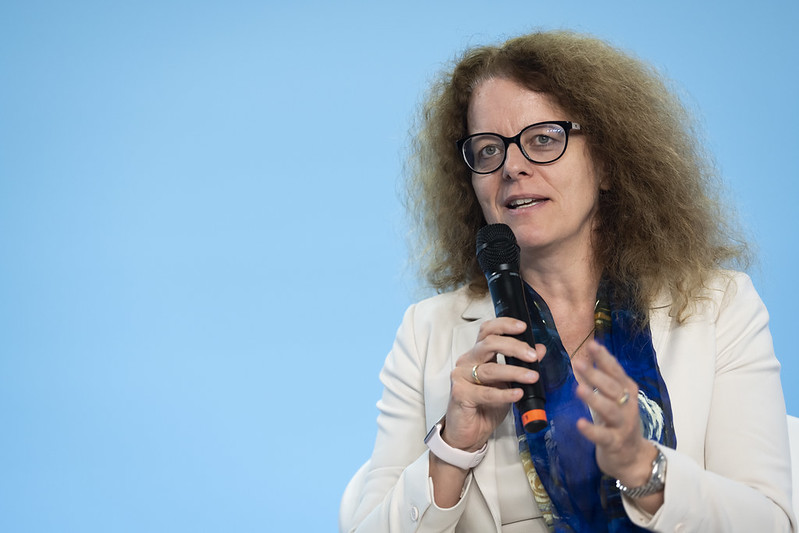
By David Barwick – FRANKFURT (Econostream) – European Central Bank Executive Board member Isabel Schnabel on Wednesday argued that the widely cited narrative of a declining Europe is “misleading.”
Pointing to quality-of-life indicators, Schnabel said in a Financial Times opinion piece that Europe’s social protection, healthcare access and affordable education support “secure, fulfilling and prosperous lives.”
She also described Europe’s democratic institutions, rule of law and media freedom as a comparative advantage that provides “stability, predictability and trust” amid a global drift toward autocracy.
Differences in social choices help explain why Europe can look weaker on conventional output metrics, she wrote, citing ECB staff calculations that if Europeans worked as many hours as Americans, about two-thirds of the real GDP-per-capita gap would disappear.
Inclusion was another contrast, Schnabel wrote, arguing that growth in the median US state and the median euro-area country has moved broadly in tandem even as US income gains have become more concentrated.
Recent performance in parts of the euro area’s southern periphery also undercut the stagnation narrative, she argued, citing “dynamic growth” and jobs gains supported by reforms, common European funds and industrial policy.
Spain was cited as a renewables leader, while Ireland was described as a global hub for technology, pharmaceuticals and life sciences.
By contrast, Schnabel said economic strains are now most acute in the euro area’s traditional core, singling out Germany as facing headwinds from aging demographics and an export model ill-suited to a world of fraying globalization.
She wrote that targeted public investment in infrastructure and defense, alongside structural reforms, could help lift Germany out of stagnation and generate positive spillovers across Europe.
Where Europe does lag, Schnabel argued, is productivity growth—less because of a shortage of ideas than because firms struggle to turn innovation into commercial scale amid fragmented legal and regulatory frameworks.
That fragmentation functions like an “internal tariff wall,” she wrote, adding that intra-EU trade in services is no higher than trade with non-EU countries.
To address this, Schnabel advocated creating a “28th regime,” a single European corporate framework that would let companies expand across borders without repeated legal reinvention and would deepen capital markets and labor mobility.
She said the initiative should be established through an EU regulation directly applicable across member states to avoid “27 versions” of the same concept, concluding that Europe has ideas and talent but needs scale and the willingness to build it.