
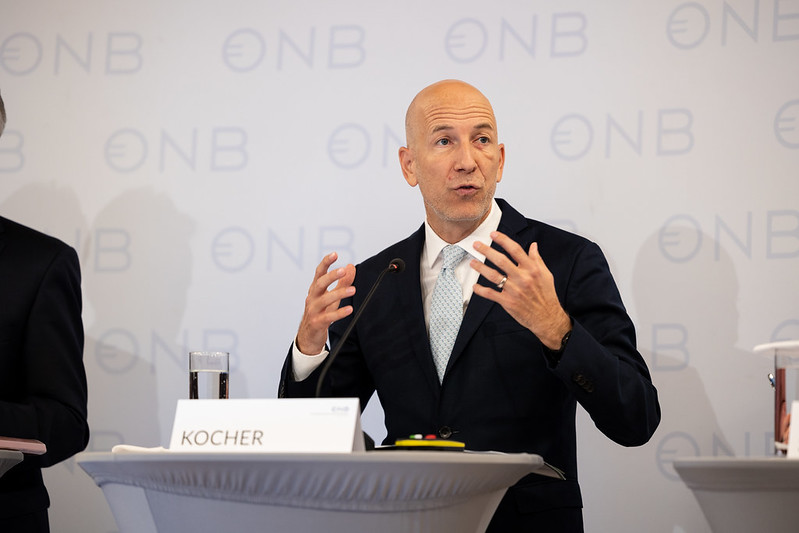
By David Barwick – VIENNA (Econostream) – European Central Bank Governing Council member Martin Kocher on Friday said that the ECB would continue to keep an eye on the evolution of the US dollar and the euro but suggested that relevant developments to date had not been problematic and to a degree could actually be viewed positively.
Speaking to media at a press club in Austria’s capital, Kocher, who heads the Austrian National Bank, said that all the various channels through which the exchange rate operated were “naturally accounted for in our inflation projections” and that there was no exchange rate objective.
He emphasized that while the dollar’s weakness, which he called “in part politically desired,” negatively impacted European exporters, the same weakness was a boon in the form of lower import prices. In this sense, he said, given its contribution to reducing overall inflation, the weak dollar could even be “seen more positively.”
“Since the fall or actually the summer, the dollar exchange rate has no longer changed strongly,” he said. The factors that had exerted the strongest effect on the exchange rate recently, namely the announcement of US tariffs and German fiscal spending plans, were “both explainable events,” he said.
The ECB would “continue to monitor” the exchange rate, he said. However, “it is always the inflation prognosis that guides us,” he made clear. “Via the exchange rate there can be an impact … but the exchange rate per se is no data point for monetary policy decisions.”
Kocher suggested that the currencies may have achieved an approximate “equilibrium,” but stressed that political decisions calling this into question were never excluded.
The euro was currently “more strongly seen as a safe haven than two or three years ago,” he said. This “also shows that we are seen as a relatively stable anchor,” he said.
Asked about the choice of Kevin Warsh to chair the US Federal Reserve, Kocher said that “what is of great importance from Europe’s perspective is that we have a stable, independent Fed.”
“Why?” he asked. “Because it’s not just about the exchange rate and the interest rates there; above all, it’s about financial market stability.” The Fed had “important duties” in this regard, he reminded, and financial market instability in the US could spill over to Europe.
It was “hard to say” just how Warsh would behave in the new role, but as a member previously of the Federal Open Market Committee, he had supported a stability-oriented monetary policy and could have even been considered a “hawk,” Kocher said.