
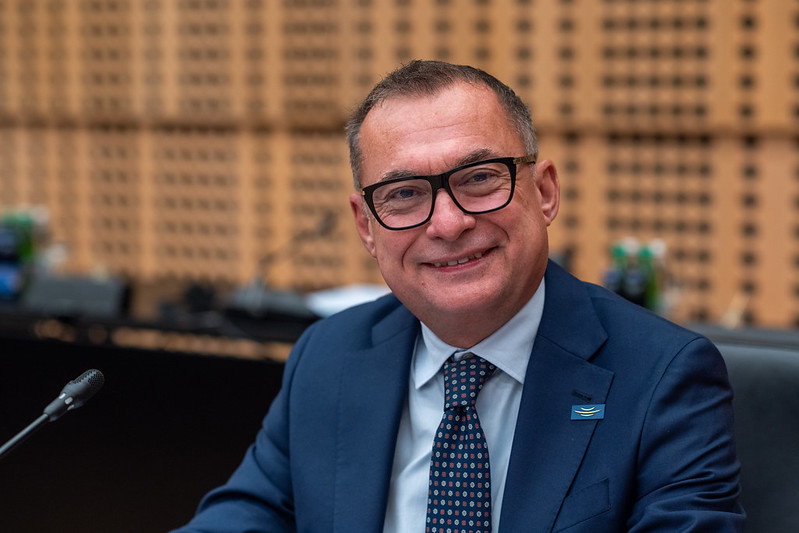
By David Barwick – FRANKFURT (Econostream) – European Central Bank Governing Council member Joachim Nagel said on Tuesday that he approved of the additional German government spending, given the current state of the world.
Asked in a panel at the World Economic Forum whether new fiscal spending by Berlin would create problems, Nagel, who heads the German Bundesbank, said, “We are living in extraordinary times and I believe it was necessary that the German government came up with such a big fiscal package.”
The spending was warranted by the need to ensure defense “but also what is necessary on the infrastructure side,” he said.
The spending, he said, would have a “positive effect” on the economy this year that would continue in 2027, he said. The German government “did it right to launch” this spending program, he reiterated.
The fact that Europe was not a fiscal union was “not a problem, but from time to time it could be challenging,” he said, pointing to the substantial heterogeneity across member countries.
“At the end it is important that fiscal is playing an important role, but shouldn’t contradict what we’re doing on the monetary side,” he said in a plea for responsible spending. Extraordinary times shouldn’t be used as an “excuse” to spend irresponsibly, he said.
The day would come when fiscal consolidation would be unavoidable, he cautioned. Authorities across Europe all “know their responsibility,” he said.
Nagel disputed the contention that the ECB might not have the necessary tools to set monetary policy in a volatile environment.
“I think over the last 25 years the Eurosystem showed that we have all the instruments,” he said, noting that the Governing Council had “enriched the tool kit over the time.”
The current situation confirmed that the ECB’s toolkit was commensurate with the situation, he indicated.
The ECB “did a lot and we showed our flexibility and definitely we do have the tools to do what is necessary to fulfil our mandate,” he said.
The ECB’s price stability mandate enjoyed primacy, he made clear, observing that “here we are close to our target.”
Stable prices were a “conditio sine qua non” to get higher growth, he said.
Nagel said he had never imagined that he would have to worry about the independence of the US Federal Reserve. The discussion about the central bank had become “very dangerous,” he warned.
“The US gave the Germans an independent central bank in 1948,” he reminded, and precisely this enabled the long spell of high growth that followed.
Fed Chair Jay Powell had a” tremendeous track record,” he defended his US counterpart. “I would be very, very cautious about the independence of central banks.”