
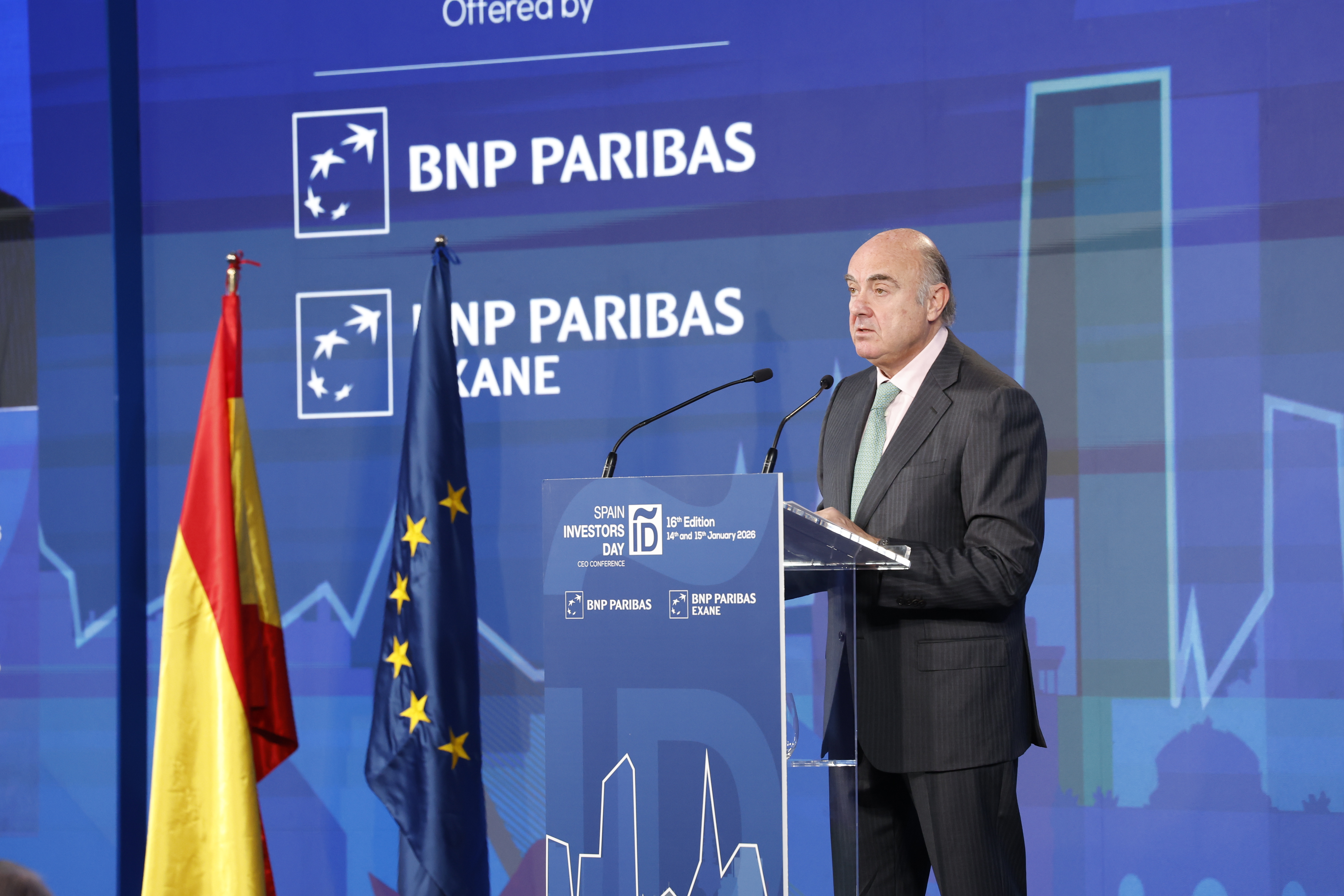
By Marta Vilar – MADRID (Econostream) – European Central Bank Vice President Luis de Guindos said on Wednesday that rising geopolitical tensions significantly increased downside risks to economic growth and that wage growth was expected to moderate in the coming quarters and stabilize toward the end of 2026.
In a speech at the Spain Investors Day conference in Madrid, de Guindos said that high uncertainty had an impact on growth by postponing investment decisions and encouraging households to save more and consume less.
“At the same time, fiscal policy in several euro area countries is set to ease to accommodate higher spending, including for military and security purposes,” he said. “In this environment, disrupted trade patterns can further complicate inflation dynamics.”
Inflation remained at a “good place,” he said, adding that it had moved around a “narrow range since the spring” while standing at 2.0% in December 2025.
De Guindos said energy prices had fallen compared with a year earlier and core inflation had eased mildly.
Although wage growth exerting upward pressure on core inflation, he said that more forward-looking indicators were suggesting wage growth would slow down in the coming quarters, stabilizing in late 2026. “Our most recent assessment reconfirms that inflation should stabilize at the 2% target in the medium term,” he said.
De Guindos described economic growth as “resilient” despite a challenging backdrop, citing GDP growth of 0.3% in the third quarter of 2025 supported by stronger consumption and investment.
Economic projections had been revised up to over 1% in 2025 and 1.4% in coming years, he said, adding that in the current environment, domestic demand was to be the main driver of growth in the following quarters.
“Business investment and substantial government spending on infrastructure and defense should increasingly underpin the economy,” he said. “Consumption is also expected to rise but the household saving rate is only gradually coming down from still elevated levels.”
Given the euro area’s openness, the economy remains vulnerable to external shocks stemming from geopolitical and trade tensions, he said, citing China as “increasingly competitive in key export sectors of euro area countries, with its share of global exports rising steadily, particularly in advanced manufacturing and green technology sectors.”
Geopolitical risk increased downside risks to growth significantly, he said, and countries more dependent on trade or facing higher public debt were at higher risk of spillover effects and resulting pressures to the downside.
Inflation, he said, could move in either direction, lower if higher US tariffs dampen demand for euro area exports or excess-capacity countries boost shipments to the bloc, or higher if global supply chains become further fragmented.
Related articles: