
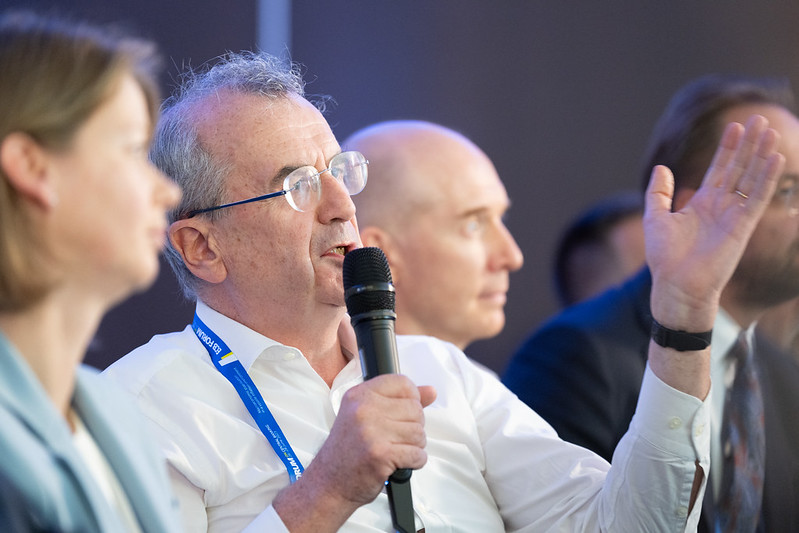
By David Barwick – FRANKFURT (Econostream) – European Central Bank Governing Council member François Villeroy de Galhau on Monday argued that ECB interest rates were unlikely to rise in 2026 absent an “unlikely shock,” saying inflation had returned to target.
In a New Year address, the Banque de France governor pointed to euro area inflation of 2% and French inflation of 0.7% in December and said the ECB had met its objective without a recession or a significant rise in unemployment.
He dismissed expectations that the central bank could tighten policy this year. “Barring an unlikely shock, this is a fanciful theory,” Villeroy said.
Underlying inflation had fallen back to 2.3%, he said, while wage moderation, low-cost Chinese imports and the possibility of a weaker dollar if Federal Reserve independence were challenged all argued against higher rates.
He also rejected what he described as a France-specific claim that euro area monetary policy was overly restrictive compared with the United States. “[T]he ECB is already far more accommodative than the Fed,” Villeroy said.
He contrasted the ECB’s 2% deposit facility rate with “3.62% for US rates and 3.75% for UK rates,” and said public-sector securities on the ECB balance sheet still amounted to 22% of GDP versus 14% in the United States.
On the Fed, he voiced support for Chair Jay Powell amid debate over the institution’s autonomy. “I want to reiterate loudly and clearly my full solidarity and my admiration for Jay Powell, a model of integrity and commitment to the public interest,” he said.
Turning to longer-term yields, Villeroy noted that the 10-year French OAT rose to over 3.5% in 2025 and argued that euro area monetary policy was not responsible.
He attributed the move mainly to “a combination of expansionary fiscal policies in several advanced economies and higher inflation expectations in the United States.”
French public finances were the country’s “cardinal weakness,” he said, arguing that reducing the overall public deficit to a maximum of 5% of GDP in 2026 was both “indispensable” and “still achievable.”
Failure to lower the deficit again in 2026 risked “a triple suffocation,” he said, via higher debt-service costs, a higher cost of financing linked to France’s spread and an intergenerational burden.
Villeroy said debt interest payments would rise by EUR 70 billion over ten years, limiting room for core priorities, and criticized recent fiscal choices as favoring higher pension and health spending for seniors financed by larger deficits for future generations.
As a practical path, he called first for stabilizing public spending “in volume terms,” and urged taxation that was more stable and more equitable while warning that parliamentary “tax creativity” was already weighing on entrepreneurs’ morale.