
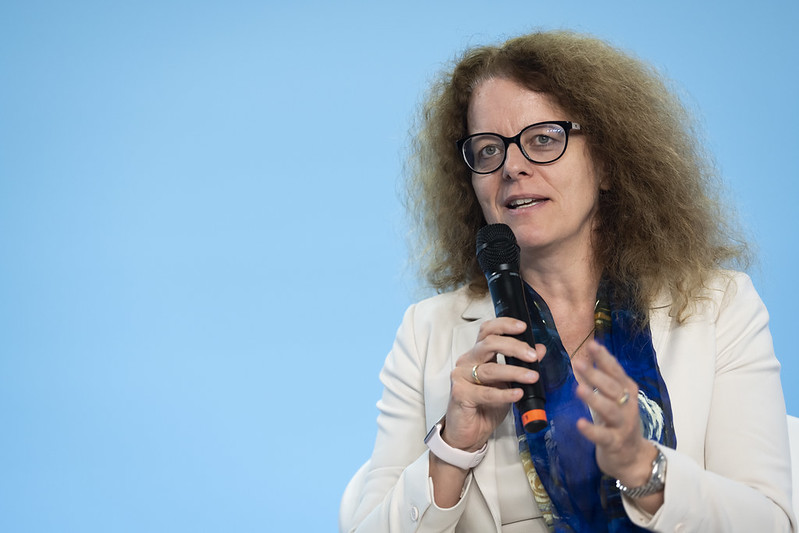
By David Barwick – FRANKFURT (Econostream) – European Central Bank Executive Board member Isabel Schnabel on Monday said that the ECB was content with the inflation situation at the moment.
In a podcast with German daily Frankfurter Allgemeine Zeitung, Schnabel said that in the context of last week’s decision to leave rates unchanged last week, “we repeated this sentence again, which has shaped the last meetings: 'We are in a good place.'"
“And by that we mean that, on the one hand, current inflation is close to our inflation target — so it’s at 2.1% in the euro area – and at the same time, our inflation forecast over the next years is in the area of 2%, and therefore we are quite satisfied with the current inflation situation,” she continued.
Such a situation was “by no means a given,” she said, noting that “other major central banks at the moment are having a harder time of it.”
In coming up with the updated macroeconomic forecasts, she said, “the surprise for some was simply that these projections turned out very positive,” with economic growth “revised slightly upward” and inflation having “also come back closer to 2%.”
The economy had “proven more resilient than many had thought,” she said. Trade disputes had dampened exports, she said, “[b]ut at the same time we had relatively stable and steadily growing domestic demand, and that then offset the shrinking of net exports.”
Growth had thus been “clearly better than we thought a few months ago,” she said. “Of course, the labor market has helped as well; it is still relatively robust, and that is very, very important for private consumption.”
“On the inflation side, the big surprise was the development of wages,” she continued. “Namely, wage growth was noticeably stronger than we had thought. It is still coming down, but more slowly than we had thought. And services inflation was stronger than we had thought, and all of that then led to broad agreement in the Governing Council that one can leave interest rates unchanged. But it was also the case that we kept all options open, so that we are in a position to respond to new data.”
Inflation was currently subject to both upside and downside risks, she said. The former included wages, in addition to which “it can be that there are disruptions in supply chains — like we saw with rare earths.”
Government spending could also lead to price pressures, she said.
On the downside, Schnabel mentioned the exchange rate and the possibility of China rerouting its exports to Europe, though this was “so far not on a large scale,” she said.