
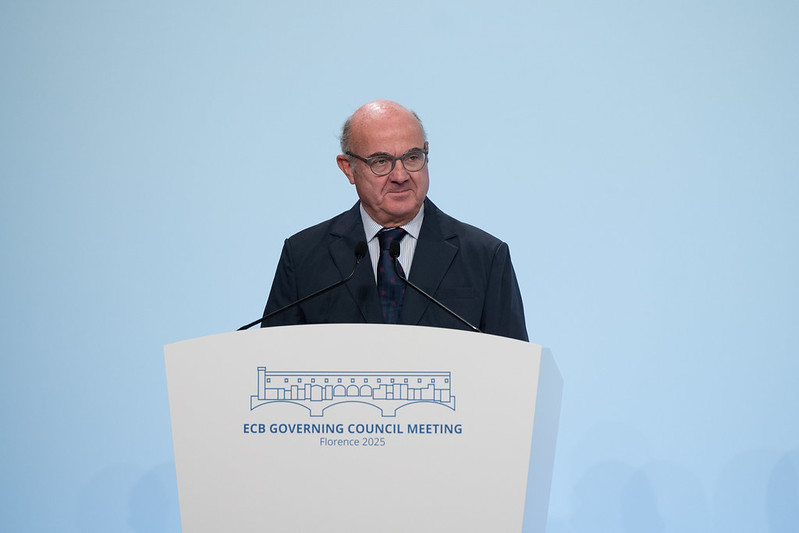
By David Barwick – FRANKFURT (Econostream) – European Central Bank Vice-President Luis de Guindos said the current level of interest rates remained appropriate and that policy would adjust only if the economic environment changed, according to an interview published Monday.
“Our monetary policy decisions are based on inflation developments, which are good, inflation projections, which are also good, and the transmission of the monetary policy,” he told Spanish daily El Periódico.
Market pricing pointed to stability, with neither rate increases nor cuts expected in the coming months, but any change would depend on incoming data, he said.
“What we are saying is that the current level of interest rates is appropriate based on the three variables I just mentioned,” he said. “Although, obviously, given the level of uncertainty and unknowns in the international geopolitical environment, we are open to adjusting it.”
Asked explicitly whether the baseline scenario was a prolonged hold, he declined to endorse the idea. “My feeling is much more open, and it will depend on the data we receive,” he said.
Growth risks were now seen as balanced and the economy had improved modestly, he noted, though geopolitical uncertainty remained a reason for caution. He also dismissed the idea of a split within the Governing Council, saying that while differing views existed, there was consensus around the current stance.
On financial stability, de Guindos warned that equity valuations remained exposed to reversals should confidence in the artificial intelligence growth narrative weaken.
Risk premia were compressed, volatility low and gains highly concentrated, he said, though unlike the dotcom era, today’s firms had proven business models and profits, making a bubble less likely. Still, “valuations may suffer a correction if this benign narrative doesn’t actually materialize,” he said.
He reiterated concerns over non-bank financial institutions, pointing to high leverage in hedge funds, opacity in private market valuations and liquidity mismatches in open-ended funds.
Strong interconnectedness with banks meant an incident in private equity, private credit or hedge funds “could have an impact on the European banking sector, which is nevertheless in a robust position,” he said.
Regarding what de Guindos called “fiscal challenges,” he deemed it “crucial to send a message of fiscal stability in line with political stability.”
Growing defense spending needs and political instability around budget approval heightened the importance of credible medium-term fiscal plans, de Guindos said. The warning was general rather than directed at any specific country, he added.
Turning to the United States, he said any perception that the Federal Reserve lacked independence could push interest rates higher. “If the market believes that a central bank is not independent, interest rates will tend to be higher and households and firms will borrow at higher cost,” he said.
De Guindos appeared to acknowledge that Spain would likely lose its seat on the ECB Executive Board when he departs next year. For a large economy, “it is important to have a presence at the top of the ECB,” he said, though future appointments would be a matter for Madrid.
Asked about the prospects of former Banco de España Governor Pablo Hernández de Cos as a potential next ECB president, he was non-committal but complimentary. De Cos had “restored Banco de España’s reputation” and now holds a senior post at the BIS, though “many factors come into play when these decisions are made,” he said.