
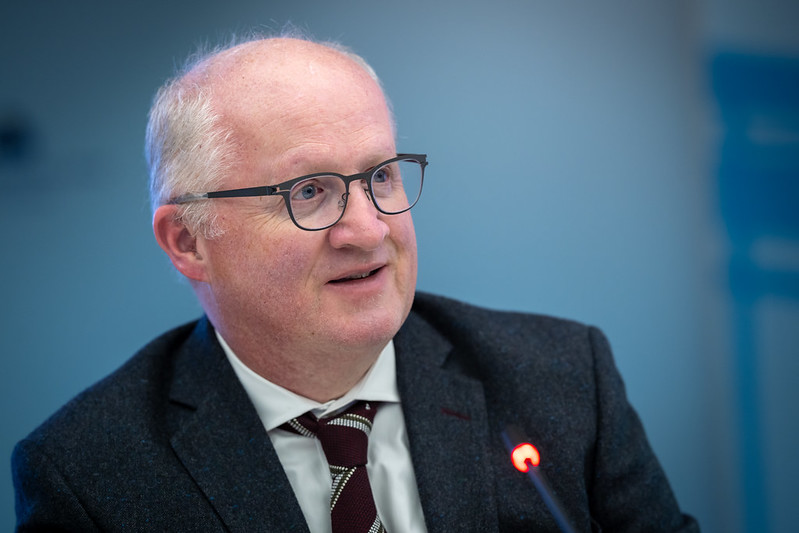
By David Barwick – FRANKFURT (Econostream) – Following are key sections of comments by European Central Bank Chief Economist Philip Lane on Wednesday at the Santander CIB Event in Paris:
- “Compared to the worst fears in quarter 2, the tariff situation has been less severe than originally feared. The level of uncertainty has come down, and of course the US economy has been fairly robust, both because of the AI dimension and the fiscal support. Let me also say that when you think about the export sector, it's this two-sided squeeze. It’s the squeeze from the tariffs vis-à-vis the US, but it’s also the squeeze from the rise of China as a greater rival in export markets for European firms.”
- “So if I turn to inflation, inflation has been around the 2% target. But let me emphasize is, that overall number is a bit flattering. Because what we have is non-energy inflation at two and a half [percent], and energy deflation. … So, for the sustainability of inflation at 2%, we do need to see more deceleration in non-energy inflation. We’re confident that’s going to happen, because everything we look at tells us wage dynamics are set to decelerate further. … And so already we know a lot about 2026 wages, because a lot of unions and employers have signed contracts across Europe. And those built-in contracts have further wage deceleration next year, and our surveys also have it. So if you like, where we are now with inflation is we have the economy growing, unemployment at a historic low. Other hand, we have this wage deceleration, we have the appreciation of the euro, we have the drop in oil and gas prices, and we have the deflationary effect of Chinese exporting firms lowering their prices. And this is why the overall trend in inflation being around target remains a push-and pull between those different factors.”
- “So, what we do have in the September projections, which are our most recent projections, is that there would be next year below-target inflation. So, it’s already in the baseline of having a phase of below-target inflation. … From the point of view of the energy markets over the course of this year, the price of oil has fallen 13%, the price of gas has fallen 34%. This is a big energy negative shock. From the European point of view, that reduces the price level. From a terms-of-trade point of view, since we import so much oil and gas, it’s also positive, you know, for the wealth effect channel for Europeans. … One project over the last year which finished mid-summer was a strategy review of how we do monetary policy. And one of the main messages out of that strategy review was to add greater weight to the risk distribution. So, the baseline is never more important than under uncertainty; the world really wants to know what’s the most likely path. But we also have to think carefully about that risk distribution. And so – and I’ve been a very strong advocate of that – is let’s be humble about trying to grade upside and downside risks. You have to do it as an investor. I don’t have to do it as a monetary policymaker. Because we will change our minds every six weeks. So, I, you know, we try to be fairly emphatic about saying we’re looking at everything. We’re looking at every risk. … A lot of these risks are not something that repeatedly show up in the historical distribution. So, trying to estimate where are we in the probability distribution is really difficult. So, what we do in our monetary policy statement is we list the risk factors. So, we’re looking at the China deflation issue, we’re looking at currency appreciation. Currency appreciation has been here forever, energy prices have been here forever. So, we do publish on that, lots of what-if scenarios. So, you can keep track. If the currency moves by x, what’s the likely effect on our projections? If oil prices move, what is the likely effect? But when you get to tariffs … we really do have to be data-dependent, meeting-by-meeting on that. So, what I would say is the baseline does have this phase below-target inflation. And in that sense, you know, there’s clearly a downside orientation for now. What I would say is in relation to the upside risks, we obviously had a very big upside realization in ’21, ’22, when inflation went to 10%. But that was so unusual in its origins between the pandemic and the war that it’s very difficult to see that kind of massive upside risk being realized. So, the upside risks I would say that we’re focusing on is, number one, a faster recovery in the European economy. We do have to, you know, allow for that. But, you know, as I say, right now we’re not seeing a super-strong European economy. … So, that’s a demand-led inflation: faster recovery, stronger labor market, all of that. The other scenario would be some unexpected deterioration in the trading environment. We’ve seen various countries approach danger lines, for example, danger lines that might lead to loss of access to certain resources from China. But if those danger lines were crossed, then the scenario where the world economic would be kind of plagued by bottleneck factors could come back. But let me emphasize, in that scenario you could get inflation jumping, where you’d have a major hit to the economy. And that scenario, a very negative supply shock, is clearly different in its implications than the European economy growing more quickly, the AI kind of global boom prompting investment globally and so on. That’s much more of a kind of benign demand-side inflation."