
Exclusive: ECB’s Kazāks: Rates Appropriate as They Are, Market Pricing “Broadly Reasonable”
19 January 2026
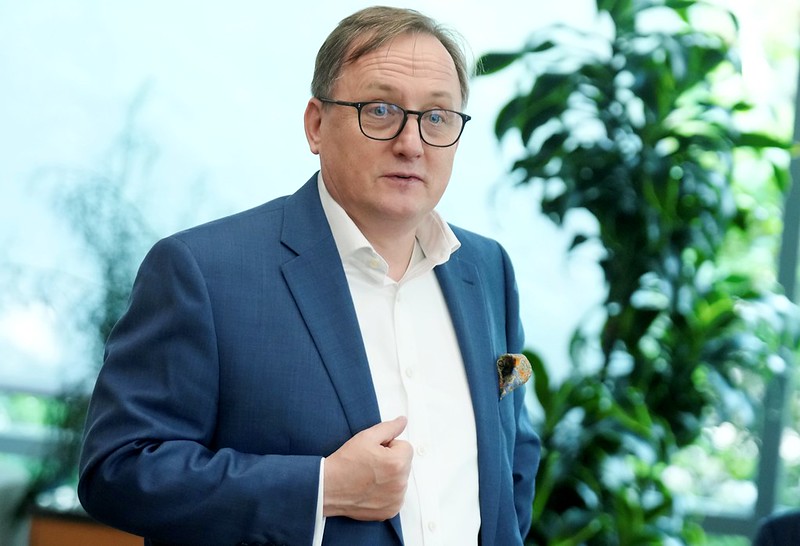
By David Barwick – FRANKFURT (Econostream) – The European Central Bank’s current interest rate level is appropriate and financial markets’ rate expectations appear broadly aligned with the baseline outlook, according to European Central Bank Governing Council member Mārtiņš Kazāks.
In an interview with Econostream on Thursday (transcript here), Kazāks, who heads Latvijas Banka, framed the ECB as being in a “good place,” while emphasizing that policy would remain meeting-by-meeting and fully data-dependent.
Kazāks defined that “good place” as a combination of inflation being near target, a baseline projection that keeps inflation around 2% with only “relatively minor deviations,” and a still-robust baseline despite elevated uncertainty and two-sided risks.
“This all adds up to being in a good place, and it means that we don’t need to make any abrupt policy adjustments,” he said. “We don’t have any ‘unfinished business’ in terms of interest rates, either; if the baseline macro scenario holds, rates are appropriate as they are.”
At the same time, he argued that the current setting preserved flexibility rather than constraining it. “With interest rates at 2%, we are well positioned to move in any direction if the situation warrants it, using our most effective instrument,” Kazāks said.
He rejected the idea that repeated references to being in a “good place” could be read as an effort to rule out any policy action, describing it instead as a conditional assessment based on today’s information.
“Our modus operandi remains meeting-by-meeting: if, at a future meeting, we no longer judge ourselves in a good place, then we will act,” he said.
On market expectations, Kazāks said he would be concerned only if pricing diverged materially from the underlying macro outlook, regardless of direction. “Broadly speaking, given the uncertainty we face, expectations look reasonably aligned,” he said, adding that a significant mispricing would prompt him to ask “why, what is the reason.”
Kazāks argued that, in the current environment, the key task was not to pre-commit to a rate path but to communicate the ECB’s reaction function, given unusually high volatility and exposure to shocks.
Referring to last Monday’s remarks by other policymakers dismissing the possibility of rate increases at least this year, Kazāks explicitly invoked fellow Governing Council member Martin Kocher’s rejection on Tuesday of those comments.
The ECB was not providing forward guidance, Kazāks stressed, because uncertainty remained exceptionally high and policy needed to retain agility in either direction. “That is why it is very hard to say confidently now what will be done later this year,” he said.
Asked what could knock the euro area out of the “good place,” Kazāks pointed to a wide range of potential shocks, including geopolitical developments, financial market stress that would likely be recessionary in the near term, the possibility of an AI-driven boom-bust dynamic, downside risks tied to China and intensified competition in third markets, and uncertainty around the productivity versus demand effects of fiscal expansion.
The overall implication, he said, was that Europe needed to raise efficiency and productivity to improve resilience.
On the United States, Kazāks stressed the importance of central bank independence and accountability, warning that undermining independence risked an inflationary bias and, if expectations de-anchored, a later return to target would require more painful tightening.
He also argued that strong European institutions could bolster Europe’s global standing and support a larger international role for the euro, which he said could aid “safe haven” behavior and lower financing costs, even as he cautioned that institutional strength needed to be matched by a dynamic economy.
Turning to the contest to become the ECB’s next vice president, he said, “I am fully committed to the competition for the vice presidency,” while adding that he did not know “how likely any outcome is.”
Kazāks is one of six hopefuls to succeed Luis de Guindos later this year and last Wednesday was one of two candidates the European Parliament’s Economic and Monetary Affairs Committee said it preferred.
He pushed back against the idea that his candidacy was primarily about positioning Latvia for future ECB Executive Board openings and called for a swift conclusion to the process so policymakers could move on from “never-ending discussions and lobbying.”
Asked what he would represent in the role, Kazāks said, “The pragmatism that it takes to deliver on our target of 2% inflation in a volatile world,” describing a readiness to adjust as conditions change rather than “cleaving to specific positions.”
He also highlighted communication as a core element of effective policy implementation, citing his own record and pointing to last year’s Commerzbank study ranking him as the Governing Council member from whom markets receive the most reliable signals.