
Exclusive: ECB’s Rehn: Reduced Fed Autonomy Would Raise U.S. Inflation and Require ECB Reaction
8 December 2025
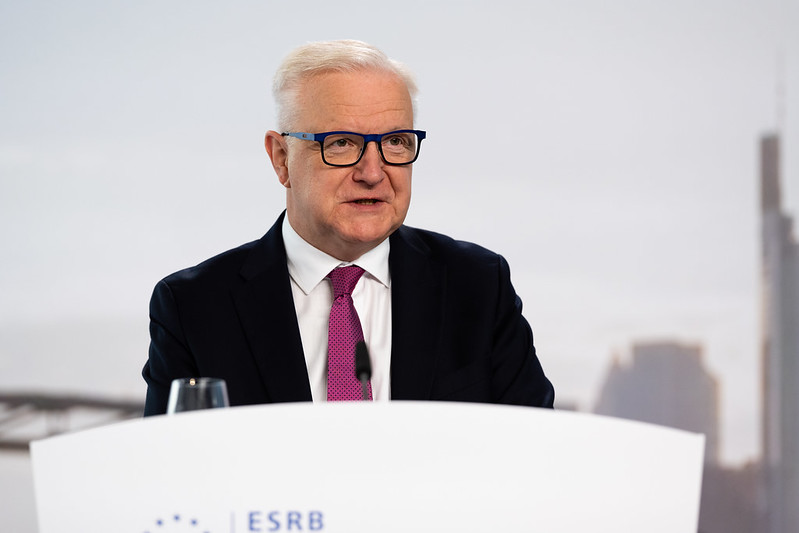
By David Barwick – HELSINKI (Econostream) – Reduced US Federal Reserve autonomy would “logically” produce structurally higher US inflation with consequences for European monetary policy, according to European Central Bank Governing Council member Olli Rehn.
In an interview with Econostream on Friday (transcript here), Rehn, who heads the Bank of Finland, declined to comment specifically on current Fed Chair Jerome Powell’s presumptive successor, but said that the threat of a loss of independence at the US central bank required careful assessment by the ECB and was a matter of concern well beyond the euro area.
“[A] serious reduction of autonomy in the case of the Fed would logically lead to structurally higher inflation in the US, and this would lead to consequences in Europe that we would need to tackle based on our primary mandate of price stability, one element of which is the exchange rate,” he said.
Rehn’s comments were similar to remarks last Monday by ECB Vice President Luis de Guindos, who warned in the context of political developments in the US that “[t]here is evidence that independent central banks control inflation better.”
Rehn, a leading candidate to succeed de Guindos as ECB vice president next June, said, “[W]e are concerned about central bank independence in the United States, given the political pressure on the Fed, and we take that into account in our monetary policy scenarios. … This is an important issue for all of us globally.”
Turning to the ECB’s own policy stance, Rehn endorsed unequivocally the symmetry of the ECB’s medium-term inflation target while avoiding any hasty conclusions about what could or should happen to interest rates. These, he reminded repeatedly, should go where the data warrant.
It wasn’t so that the ECB had already foreclosed on the option of cutting again, he said.
“Personally, I am trying to walk the talk, which is sticking to the principles of full optionality, full freedom of action, and moving forward meeting by meeting,” he said.
The current constellation of risks to inflation supported this approach, he said. Wages would continue to moderate, the euro’s recent appreciation had not yet been fully digested and growth was subdued, yet at the same time, geo-economic fragmentation or unexpectedly resilient growth could boost price pressures he said.
“So, downside risks dominate slightly for the moment, but there are also upside risks,” he said.
The policy environment, which he characterized as “a thick cloud of pervasive uncertainty due to geopolitics and trade wars,” further argued for preserving optionality and basing decisions on all available information at the appropriate moment, he said.
Rehn doubled down on his previous rejection of pre-emptive easing. “We’re not in the insurance business — not in December, March or June,” he said in dismissing a so-called insurance cut. His opposition to such a cut would thus remain valid for the foreseeable future, he indicated.
The ECB’s ability to look through some deviations of projected inflation from the 2% target hinged on the solid anchoring of expectations, he reminded. That condition, he appeared to suggest, was satisfied.
“So far, I would underline that inflation expectations have remained quite well anchored around our 2% target,” he said.
As for fiscal decisions in the euro area’s largest economy, he expressed confidence that Germany would ramp up its spending as planned and that these would prove a significant economic impulse for the region.
“These are budgetary decisions, so they are legally grounded decisions now,” he said. “So, I’m certain that these budgetary decisions will be executed effectively, and they will have a formidable positive impact on the European economy and the German economy.”
Financial system vulnerabilities, in particular high asset valuations, were no sudden development, acknowledged Rehn, who also serves as first vice chair of the European Systemic Risk Board. Much of the current wave of investment in artificial intelligence involved taking on debt via private credit to finance data centers, ultimately exposing the banking system, he observed.
This linkage between the banking system and private credit was thus “a matter of concern, and that’s what we are looking at,” he said.
“We have to be mindful of systemic risks to financial stability,” he said. “Having said that, they don’t have an immediate impact on monetary policy, because they have not materialized, and we cannot make monetary policy outside the perimeter of concrete data and economic analysis.
Rehn also reflected on his candidacy for the ECB vice presidency, acknowledging the encouragement he had received from colleagues across Europe. Drawing on decades of experience in crisis management, financial stability oversight and European policymaking, he described the vice presidential role as fundamentally collaborative.
“In that sense, the work of the vice president is measured by the success of the whole European Central Bank,” he said.
At the same time, the standard division of labor at the ECB envisioned the vice president taking responsibility for euro area financial stability, he noted. Having been policy advisor to Finnish Prime Minister Esko Aho from 1992 to 1993 and thus during the thick of the country’s own banking crisis, he could draw on relevant experience, he said.
The lesson of that episode was “never again,” he said, meaning “be pre-emptive, maintain resilience.”
As European Commissioner, Rehn was also involved in managing the Eurozone’s more recent crisis. As noted, he is first vice chair of the ESRB, and currently part of the high-level task force that seeks to simplify European banking system regulation without compromising safeguards.
“I trust this has given me reasonably strong background so that I could perform well the tasks of [ECB] vice president,” he said.