
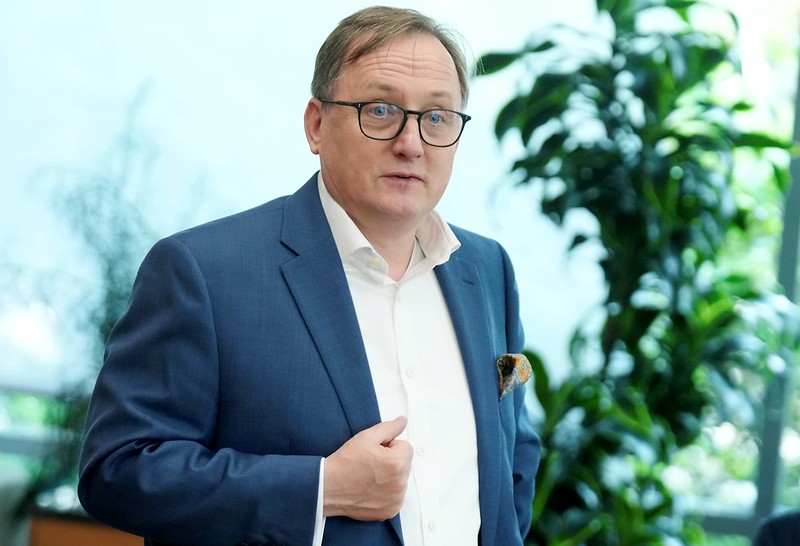
By David Barwick – RIGA (Econostream) – European Central Bank Governing Council member Mārtiņš Kazāks said Wednesday that further monetary tightening was “not a race toward much higher rates” and that policymakers needed to consider whether additional increases would unnecessarily harm growth if inflation was credibly projected to subside over the next 12 to 18 months.
In an interview with Econostream (transcript here), Kazāks, governor of the Bank of Latvia, said that some further tightening remained necessary and that a December rate increase was “quite likely”, while stressing that the current inflation outlook did not require a long series of significant consecutive hikes.
“Under the current inflation outlook, some tightening is still needed, but this is not a race toward much higher rates. We are around the point where monetary policy starts to become contractionary”, he said.
“Moving further into restrictive territory to bring inflation down does not require a long set of significant consecutive hikes to deal with the current outlook,” he added.
Kazāks said policymakers needed to consider the delayed effects of their decisions when assessing how much additional tightening was warranted.
“But we also have to consider policy lags. A monetary policy move takes full effect over the next 12 to 18 months”, he said.
“If the forecast credibly shows inflation subsiding over that period, we need to consider whether further tightening would do unnecessary harm to growth,” he said. “Higher yields, including spillovers from US interest rates, also restrain growth and reduce the risk of second-round effects.”
Kazāks said the shape of the projected inflation path, particularly next year, would be important to his assessment.
“I need to see the forecast, particularly the shape of the inflation hump. If inflation starts to fall quickly, that would strengthen our credibility and mean we need to do less”, he said.
“The projections will extend to 2029, but the outlook for next year is much more important as short term forecasts have better precision,” he said.
Asked how wage settlements at or below the assumptions in the projections would affect the case for further tightening next year, Kazāks said a reduced threat of second-round effects would allow a less aggressive response.
“Second-round effects are the big concern, because containing them requires a more aggressive response. If they become less likely or less important, that is good news and means we can be less aggressive. Again, we need to avoid unnecessary harm”, he said.
Kazāks distinguished the current shock from the previous inflation episode, citing differences in both the level of inflation and the ECB’s credibility.
“Inflation at 4% or above is high enough for households to pay attention and change their behavior. But it is probably not yet at a level where nonlinear effects are extremely likely. Four or four and a half percent is very different from eight or ten percent”, he said.
“We also entered the previous shock with less credibility, having allowed inflation to overshoot significantly for quite some time," he continued. "Our starting point and the nature of this shock are different.”
Kazāks cautioned that his assessment assumed no further significant shocks, which he considered unlikely.
“A gradual approach remains appropriate to allow us to take account of other shocks potentially arriving”, he said.
Kazāks nevertheless reiterated that some further tightening was necessary and described a December increase as “quite likely” though not a foregone conclusion.
“First, we decide meeting by meeting. A December hike is quite likely, but the meeting is still ahead of us. In my view, some further tightening is necessary, but we will see when and by how much”, he said.
Asked whether the ECB could pause after December with less of a bias toward further tightening, Kazāks said policymakers should remain ready to act.
“Second, I wouldn’t frame next year as a time to become more relaxed. We should continue to assess the data and geopolitical and political developments, and act when necessary”, he said.
Kazāks expressed concern about gradually rising household inflation expectations, warning that a continued increase would require an immediate response.
“For example, there is some creeping up in household inflation expectations. It’s very gradual, not critical, but I don’t like it. If it’s on that path, you need to be very, very cautious”, he said.
“If expectations keep rising, our credibility is at risk and we should address that immediately,” he added. “The longer inflation remains elevated, the greater the risk of second-round effects.”
Kazāks said inflation remained predominantly energy-driven and that second-round effects had yet to emerge.
“So far, it’s very much energy-driven inflation. It is broadening because of indirect effects, but we haven’t seen second-round effects. If you start to see that higher inflation is an excuse in negotiations to demand higher wages, that would be dangerous”, he said.
Asked how reassuring a benign 2029 forecast would be if the December projections showed unacceptable inflation paths for 2027 and 2028, Kazāks said the nearer years deserved greater weight.
“Most models have mean reversion built in, and forecast errors accumulate the further out you go. I would therefore attach much more importance to next year and 2028. For inflation expectations, one or two years is already quite a long time”, he said.
On pipeline price pressures, Kazāks cautioned against assuming that companies would continue absorbing higher costs.
“So far, profit margins have absorbed part of the increase in producer prices. But we cannot assume that will continue if cost pressures persist or intensify”, he said.
“We are data dependent, not data-point dependent,” he said. “We look at a broad range of information, and the relative importance of the indicators can change with the context.”