
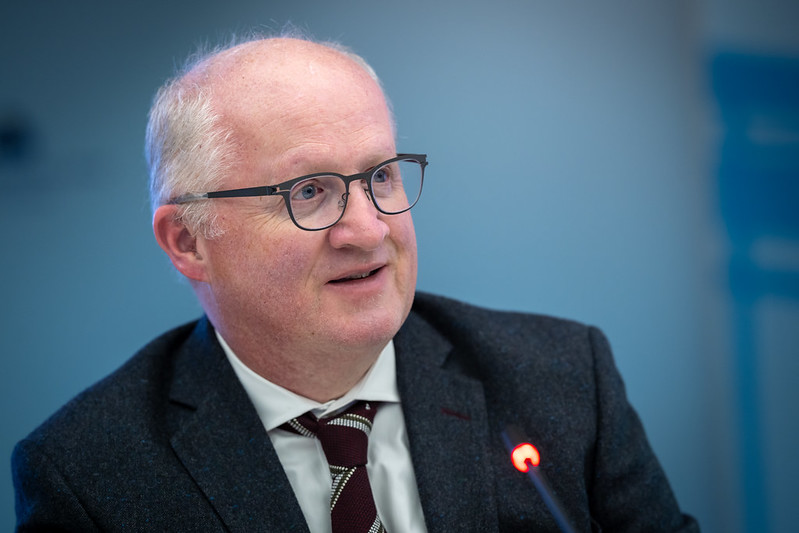
By David Barwick – FRANKFURT (Econostream) – European Central Bank Chief Economist Philip Lane said Tuesday that he would favor raising interest rates in December if the evidence available at the meeting gave policymakers the same picture they have today.
“If the information set we have in December is exactly the same as the information set today, then I think it would be prudent indeed to hike,” Lane told Bloomberg.
“This [oil prices] can move a lot between now and December, I think in either direction, given the uncertainty,” he added. “Oil and gas, financial conditions, they can move a lot.”
Lane expected inflation to finish the year just above 4%. He pointed to the first quarter of next year as a period when food and core inflation were especially likely to pick up, while allowing for sizable swings in oil prices before the December meeting.
“There will be more to come in terms of peak inflation,” he said.
“This time we don't think the shock is travelling fast, but it's still travelling,” he said, contrasting the current energy shock with that of 2022.
Lane said the ECB would have to assess the strength of the spillover from energy prices to other components of inflation, as well as the speed at which inflation might decline next year.
“I think what's going to be critical next year is that inflation starts to drop visibly,” he said. “That'll be important to reassure people that indeed this is a spike in inflation. It's not a new level, if you like.”
Lane said the ECB would “follow the data” next year. He described the economy’s resilience so far as “quite reassuring” and called for reforms to lift its modest growth rate.
He also stressed that tighter financial conditions could reduce the need for additional monetary policy tightening.
“That means we have a tightening of financial conditions which will slow down the economy on its own terms,” he said. “It will contain inflation on its own terms, and we would take that into account in deciding monetary policy.”
Lane cautioned against focusing too heavily on energy prices when assessing the interest rate outlook, pointing also to developments in artificial intelligence, fiscal policy and financial markets.
“What I would like to see is the market repricing in line, not just with energy prices, but the wider macro developments,” he said.
Asked about French government bonds, Lane said investors were repricing uncertainty over the country’s public finances and that France needed to clarify how it would adjust its budget.
“Where this needs to be fixed is in Paris,” he said.
“TPI is part of our toolbox, which is important,” Lane said, referring to the ECB’s Transmission Protection Instrument.
Lane said the ECB should continue to steer monetary policy chiefly through its short-term rate. He saw only a modest effect on longer-term borrowing costs from the gradual return to more normal policy settings.