
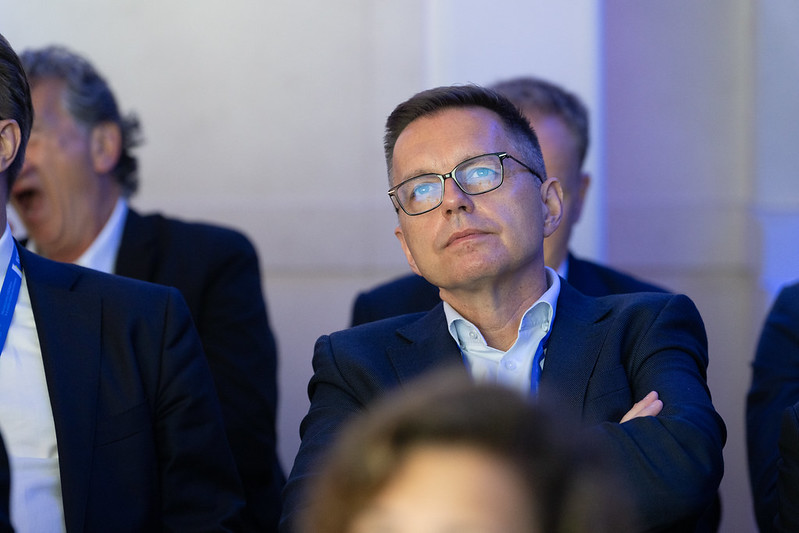
By David Barwick – FRANKFURT (Econostream) – European Central Bank Governing Council member Peter Kažimír faces a fresh obstacle to securing a second term at the head of Slovakia’s national bank (NBS) after Slovak President Peter Pellegrini said he would not reappoint him without a final court ruling clearing him of wrongdoing, adding another condition to a nomination already blocked by disagreements within the governing coalition.
Pellegrini’s intervention on Tuesday leaves Kažimír’s prospects dependent on both the outcome of his ongoing appeal against a 2025 bribery conviction and an agreement among coalition parties that have yet to settle the central bank’s leadership more than a year after Kažimír’s original mandate expired.
“Even if Parliament were to approve Peter Kažimír as the NBS governor, given that court proceedings are currently under way against him, I can state here and now that I would not consider the nomination until a final court ruling had established his innocence,” Pellegrini said, according to Slovakia’s TASR news agency.
“Until then, I would not appoint him to a second term as governor,” he added. Pellegrini also said he would remove Kažimír from his existing position if his conviction became final.
The statement creates a further barrier to reappointment without itself ending Kažimír’s current tenure. His six-year term expired in June 2025, but he continues to serve pending the appointment of a successor, meaning that he also remains a member of the ECB’s Governing Council.
His principal political backer, the coalition party Hlas, reaffirmed its support on Wednesday. Education Minister Tomáš Drucker said Kažimír remained the party’s unequivocal candidate and suggested the government and parliament could approve his nomination before submitting it to the president, according to Denník N.
There remains, however, the opposition of Smer, the largest governing party. Agriculture Minister Richard Takáč reiterated on Wednesday that Smer did not support Kažimír’s nomination, while saying the matter was not currently a subject of coalition negotiations.
The result is an impasse in which Kažimír lacks the agreement needed for a fresh mandate, while the coalition has also failed to agree on someone to replace him. Pellegrini’s position narrows the immediate route to a second term but provides no timetable for ending the holdover arrangement.
The Specialized Criminal Court in Pezinok found Kažimír guilty of bribery in May 2025 and imposed a €200,000 fine, with a one-year prison sentence in the event of non-payment. Kažimír denies wrongdoing and has challenged both the verdict and the legality of the proceedings.
His lawyers filed an appeal on 27 August 2025. The case awaits consideration by Slovakia’s Supreme Court, but the timing of a definitive resolution remains unclear. No hearing date has been publicly identified, as far as we know. An appeal ruling would not necessarily end the proceedings if the conviction were overturned and the case returned to the lower court.
Separately, police have been investigating the financing of a villa in Vence on the French Riviera owned by a company belonging to Kažimír’s partner’s family, according to a February report by Slovakian daily Denník N citing police headquarters. An investigation by the newspaper and the Investigative Center of Ján Kuciak traced €1.5 million in financing through a Cypriot company to businessman Jozef Brhel. Kažimír has denied owning foreign property, holding interests in the companies concerned or knowing about their transactions. Whether the inquiry will lead to additional charges remains unclear.
The dispute over Kažimír has also become entangled with a separate confrontation over Pellegrini’s refusal to appoint Filip Kuffa as environment minister while Kuffa faces a criminal investigation.
Andrej Danko, leader of the coalition’s Slovak National Party, has raised the possibility of a parliamentary initiative to end Kažimír’s tenure, questioning why the president objected to Kuffa’s appointment while Kažimír remained central bank governor despite a first-instance conviction.
Pellegrini presented his position on Kažimír as an application of the same standard to different public appointments. He said on Tuesday he would seek a Constitutional Court interpretation concerning his powers in the Kuffa appointment dispute.
With Kažimír’s appeal unresolved and no successor agreed, the latest political confrontation has increased the obstacles to his reappointment without providing any answer to the question of when Slovakia’s central bank leadership – and thus the Slovakian member of the ECB’s Governing Council – will change.
Among current euro area members, Slovakia has the third-worst score in Transparency International’s 2025 Corruption Perceptions Index, ahead of only Croatia and Bulgaria.