
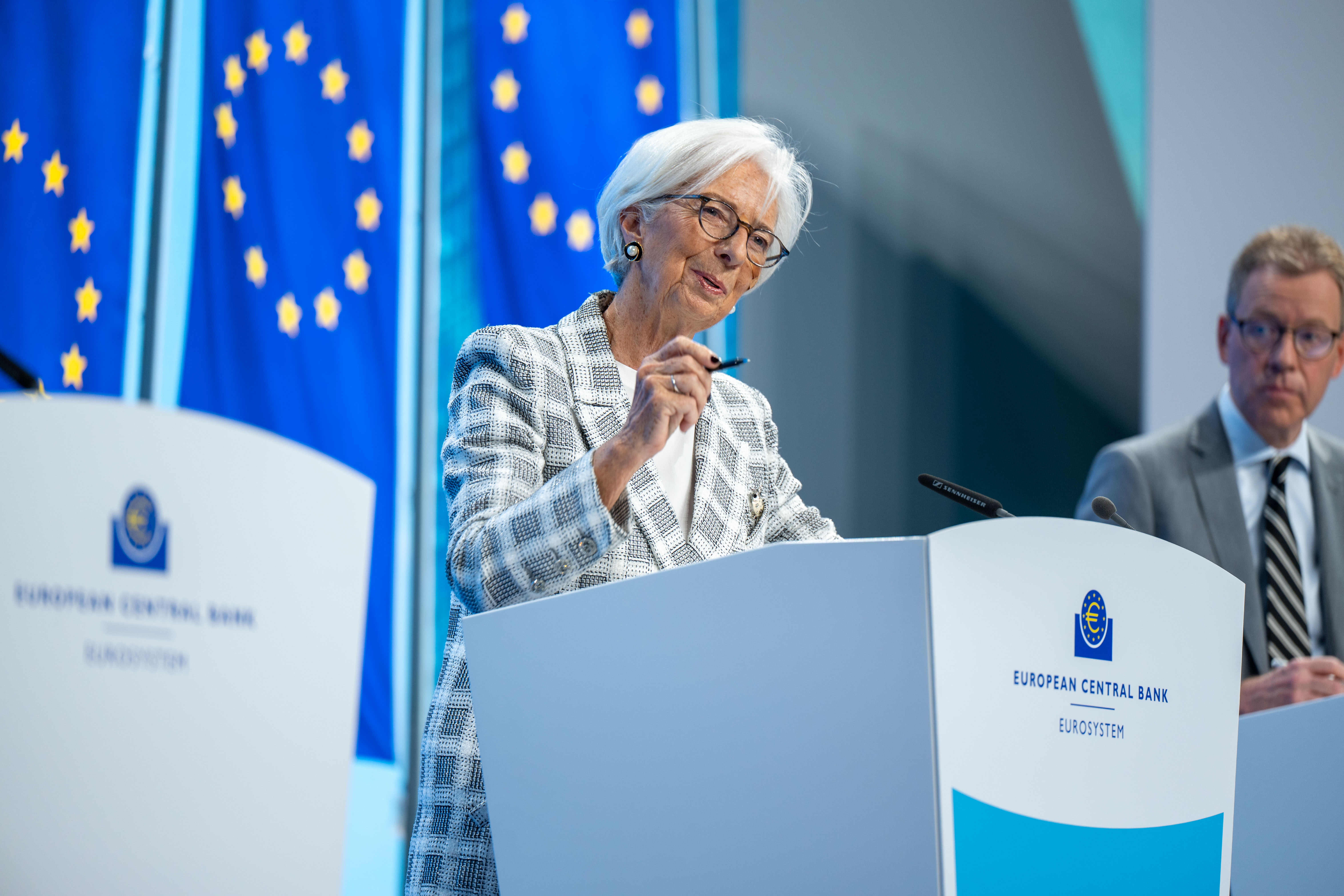
By Marta Vilar – FRANKFURT (Econostream) – European Central Bank President Christine Lagarde said Thursday that the direction of interest rates was clear barring major developments before December, after the Governing Council debated a possible rate hike but unanimously agreed to leave rates unchanged.
"Unless there were major developments, the direction of travel is quite clear," she told a press conference following the ECB's monetary policy meeting.
Lagarde reiterated the message later, saying that "if the assessment that we have today is not informed by significant developments, the direction of travel is clear."
The Governing Council discussed whether an immediate hike was warranted, with some members questioning whether the ECB should already act in response to rising inflation risks.
"There were views along the lines of: maybe now, why not?" she said.
However, policymakers unanimously agreed that they were in a sufficiently good position to wait for additional information, given heightened uncertainty, broadly stable underlying inflation and tighter financial conditions.
Lagarde acknowledged that the current situation "could have warranted a hike" and described Thursday's decision as a "no hiking decision," noting that several members had considered whether further tightening was already justified.
The ECB president highlighted two major developments since September: a significant increase in energy prices and higher long-term financing costs.
Average 10-year sovereign yields had risen by around 35bp since the cutoff for the September projections, she said, adding that the increase in financing costs had tempered the implications of higher energy prices for monetary policy.
"Energy prices have increased inflation,” she said. “Long-term financing costs have qualified the magnitude of that increase.”
Lagarde said the Governing Council had closely examined the direct, indirect and potential second-round effects of the energy shock, particularly developments in wages.
While indirect effects had increased, the ECB was not currently seeing material second-round effects beyond those already incorporated into its September projections, she said.
Looking ahead, Lagarde said the six weeks before the December meeting would provide a wealth of additional information, including updated staff projections, two inflation readings, third-quarter GDP and employment figures, wage data and bank lending statistics.
"Underlying inflation will probably take a particular standing in the three-pronged approach that we apply to monetary policy decisions," she said.
The ECB would also continue to assess the inflation outlook, risks surrounding it and the strength of monetary policy transmission, with new scenarios likely to be prepared in December.
On sovereign bond markets, Lagarde said the increase in long-term yields was a global phenomenon, partly reflecting inflation expectations, the expected path of interest rates and increased debt issuance.
She warned that highly indebted countries would need to account for financing costs that were likely to remain elevated for some time when preparing their fiscal plans.
“[S]hould market developments threaten the smooth transmission of our monetary policy, including through unwarranted and disorderly market movements, we have instruments available to respond,” she said. “And the criteria and conditions under which this applies are well known.”
On her decision to leave the ECB on February 7, ahead of the scheduled end of her term in October 2027, Lagarde said she wanted greater freedom to speak and act on matters outside monetary policy.
"The reason I'm anticipating the end of my term by leaving in February 2027 instead of October is, as I have said to colleagues, members of staff and Governors, because I want to have the freedom of speech, the freedom of expression and the freedom to engage on matters that are not monetary policy matters," she said.
Lagarde explained that the ECB presidency required political neutrality, which she no longer felt comfortable maintaining given developments around the world.
"I don't think that I can remain neutral. I don't think that I can be comfortable in that neutrality at the present time," she said.
She also expressed concern about the distortion of truth through misrepresentation, saying her experience in international economic and financial institutions gave her a perspective she wanted to share publicly.
Lagarde declined to elaborate on her future plans but insisted that her departure would not disrupt the ECB's work or monetary policy decisions.
"Until February 7, I'm in charge, I'm focused, and I will be working without any reservation, without any excuses," she said.