
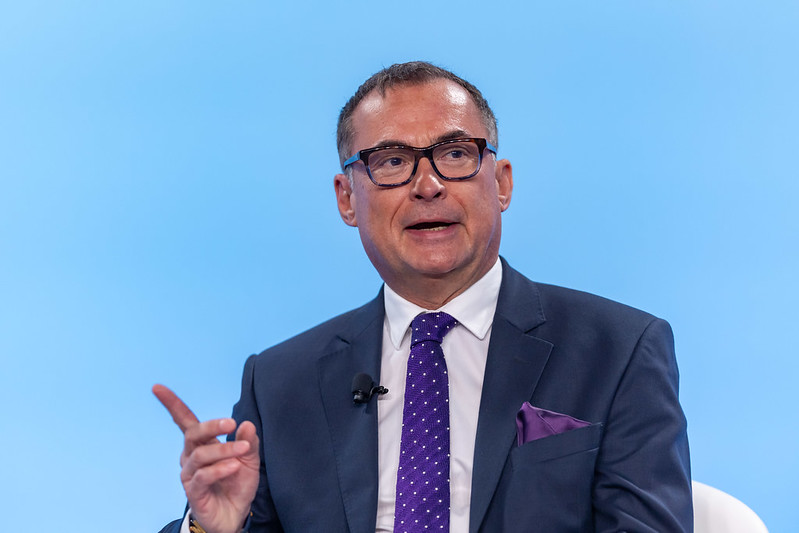
By David Barwick – FRANKFURT (Econostream) – European Central Bank Governing Council member Joachim Nagel said Wednesday that Europe needed to deepen the integration of its banking and capital markets while ensuring that efforts to simplify regulation did not undermine the resilience of its financial system.
Nagel, president of the Bundesbank, said in a speech prepared for delivery in Frankfurt that European banks remained well capitalized and liquid, but continued to suffer from structural disadvantages compared with their U.S. counterparts because Europe’s financial system remained fragmented.
“The structural weakness lies elsewhere,” Nagel said, pointing to deeper and more liquid U.S. capital markets and a more highly integrated financial system.
Fragmentation in European banking and capital markets made efficient capital allocation and the exploitation of economies of scale more difficult, while differing and sometimes contradictory national regulatory requirements added to those inefficiencies, he said.
Nagel said the answer was not deregulation aimed at releasing capital quickly at the expense of bank resilience, but rather reforms that would permanently improve the financial system’s capacity to channel savings into productive investment.
That was the purpose of the European Union’s Savings and Investments Union, which should combine deeper capital markets with greater integration of the European banking market, he said.
Nagel pointed to reforms including a more efficient securitization framework, reduced fragmentation in trading, clearing and settlement, greater use of distributed ledger technology and tokenization, deeper venture and growth capital markets, more harmonized capital market supervision and a genuine single market for banking.
He said progress was being made as political commitments increasingly translated into legislation, including the European Commission’s proposals on securitization, market integration and supervision and the so-called 28th regime creating an EU-wide corporate form.
The Savings and Investments Union would give European companies access to a broader range of investors, while deeper equity and venture capital markets could help European start-ups grow into larger companies without having to look outside Europe for financing, Nagel said.
Banks themselves stood to benefit from deeper capital markets, he said, arguing that bank financing and market financing should not be regarded as competitors. A larger securitization market, for example, could allow banks to transfer risks to capital market investors and free capital for additional lending.
Nagel also called for further progress toward completing the European banking union, including more efficient cross-border management of capital and liquidity and a common European deposit insurance scheme.
Reducing large concentrations of sovereign debt holdings could make an important contribution to further developing the banking union’s institutional architecture, he said.
At the same time, Nagel backed simplification of European banking regulation, particularly for smaller and low-risk institutions, while warning against weakening safeguards introduced after the global financial crisis.
The ECB Governing Council’s High-Level Task Force on Simplification had recommended reducing the number of components in the risk-weighted capital and leverage ratio framework and introducing a substantially simpler supervisory regime for smaller banks, he said.
Nagel said the German supervisory authorities had proposed a European regime under which small and low-risk banks would face few or no risk-weighted requirements, in exchange for meeting a higher leverage ratio.
The proposals had entered the European reform process, and the Commission was expected to take them into account when it presented legislative proposals to amend the EU banking rulebook in the first quarter of 2027, he said.
Europe had shown over the past 40 years what economic integration could achieve, Nagel said, but financial market integration remained “an unfinished chapter” with considerable untapped potential.