
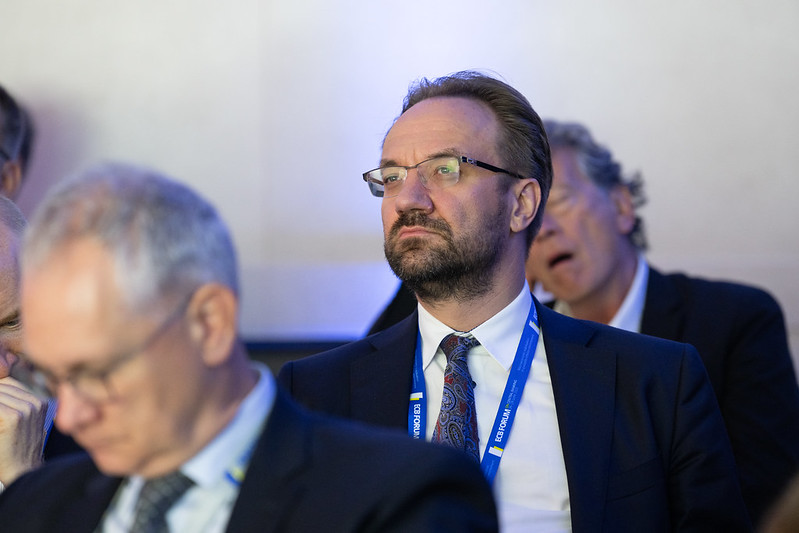
By David Barwick – FRANKFURT (Econostream) – European Central Bank Governing Council member Gediminas Šimkus said Wednesday that evidence accumulated since the September meeting suggested that some further monetary policy tightening could be needed, while indicating that December offered policymakers a richer information set than October.
Šimkus, governor of the Bank of Lithuania, told Bloomberg that the October meeting nevertheless could not be disregarded.
“We’ve received more evidence since September that suggest some tightening of monetary policy might be needed,” he said.
“From a policymaker’s perspective, you want to take decisions when you have the largest amount of data available, and the next such meeting is December,” Šimkus said. “But you also can’t ignore the fact that we have a meeting in October.”
Šimkus said higher oil and gas costs had yet to produce discernible second-round effects, though prolonged energy-price pressure would increase the danger of broader pass-through.
“The longer energy prices stay elevated, the higher the probability that they will spread,” he said.
Higher sovereign yields were working in the opposite direction, Šimkus said, although he played down concerns that recent moves in euro area bond markets necessarily constituted fragmentation.
“It’s very important to distinguish between market fragmentation and legitimate repricing of sovereign risk,” he said.
Šimkus said the rise in French government bond yields reflected markets’ assessment of country-specific economic, political and fiscal factors.
“I see the rise in French sovereign yields as a phenomenon coming particularly from the economic developments as markets are pricing the debt level, the political uncertainties and the fiscal fundamentals,” he said.
Šimkus observed that “to some extent it’s normal” for different countries to face different market borrowing costs.
“Not every increase in sovereign yields,” he added, “should be interpreted as market fragmentation.”