
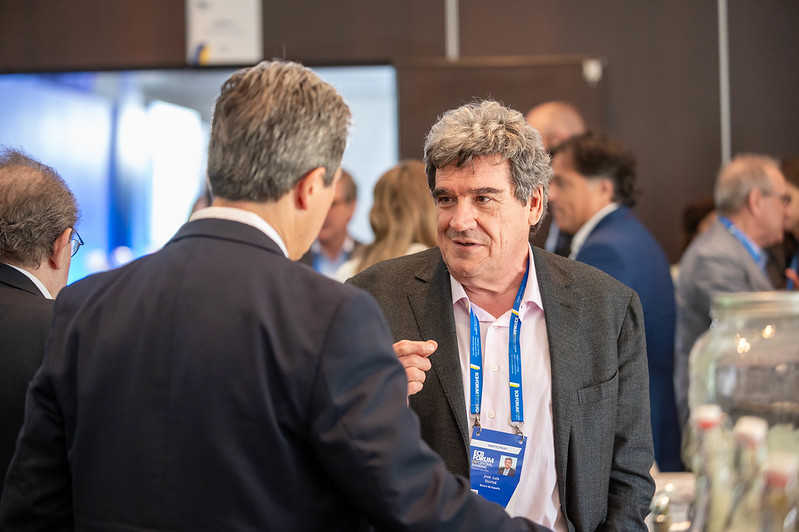
By Marta Vilar – BANGKOK (Econostream) – European Central Bank Governing Council member José Luis Escrivá said on Wednesday that Europe was poorly positioned to benefit from the rapid technological transformation of the global economy, citing excessive regulatory complexity, insufficient rewards for talent and fragmented markets.
Speaking at the Institute of International Finance Annual Meetings in Bangkok, Escrivá, who heads the Banco de España, said that Europe had world-class research institutions and highly skilled workers but struggled to translate those advantages into innovation at scale.
"Europe is not well positioned to be one of the main beneficiaries of the rapid and profound technological transformation," he said.
According to Escrivá, one of the main obstacles was the complexity of Europe's regulatory environment, which he suggested reflected deeper structural and cultural constraints.
"While we have the resources, we are not able to keep them here sufficiently," he said.
Escrivá acknowledged that Europe's emphasis on social cohesion and solidarity, and its greater aversion to inequality compared with other parts of the world, partly explained this situation.
However, he suggested that a better balance was needed to foster innovation and competitiveness.
He also highlighted the fragmentation of European markets, particularly in sectors requiring substantial investment and economies of scale, such as energy, telecommunications and defence.
Escrivá pointed to the relatively small number of large telecommunications operators in the United States and China, contrasting this with Europe's fragmented industry, which he said constrained investment in digital infrastructure.
He also cited Europe's lack of a significant low-Earth-orbit satellite industry as an example of its shortcomings in strategically important sectors.
Overcoming entrenched national interests would be essential to completing the single market and unlocking Europe's economic potential, he said.
"[W]e need the scale and we need really huge investment in some areas," he said, adding that narrow national interests were standing in the way of greater integration.
Despite these weaknesses, Escrivá said Europe could benefit over the medium term from its commitment to international cooperation, trade openness and the climate transition, particularly as other major economies increasingly embraced nationalist and protectionist policies.
He argued that Europe's approach to international cooperation could become a competitive advantage in an increasingly fragmented global economy.
- The author of this story can be contacted at marta.vilar@econostream-media.com