
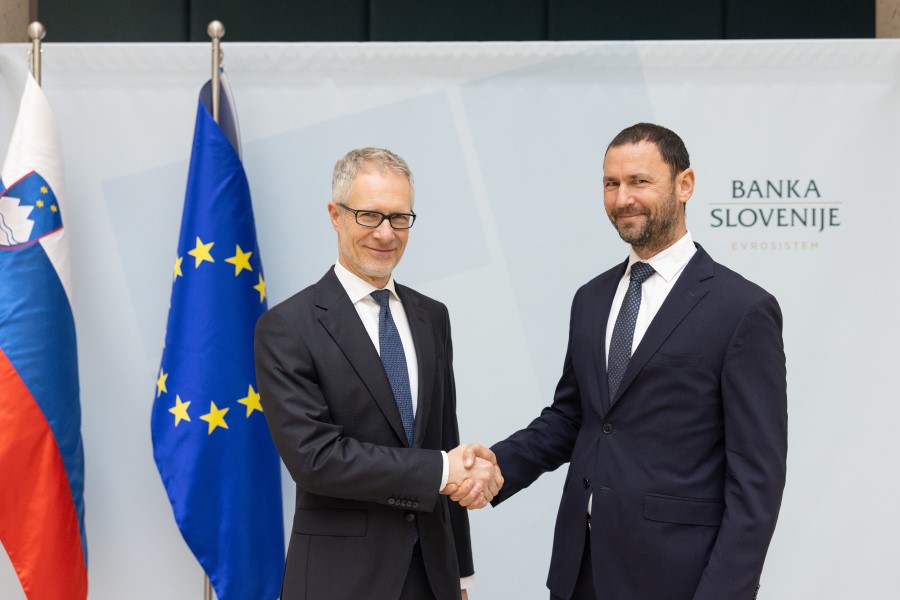
By David Barwick – FRANKFURT (Econostream) – European Central Bank Governing Council member Primož Dolenc said Thursday that persistently elevated inflation and unresolved geopolitical conflicts supported a move toward a more restrictive monetary policy stance, while leaving the timing and size of any further rate increases open.
In an interview with Reuters, the Slovenian central bank governor said future decisions would continue to depend on incoming data.
“Persistently elevated inflation that we see in our September projection and the lack of resolution of conflicts in the Middle East, Ukraine and elsewhere, supports the case for moving policy rates towards a more restrictive territory,” Dolenc said.
“But when and by how much we will determine on a meeting by meeting basis, based on the incoming data,” he said.
Dolenc declined to characterize the ECB’s current monetary policy stance as restrictive.
“I would refrain from judging whether monetary policy is currently restrictive. The answer is not clear-cut,” he said.
Separately, in a speech at a tax and finance conference in Portorož on Thursday, Dolenc said inflation of around 3% was expected to persist through the end of this year before gradually returning toward the ECB’s 2% target over the following two years in the absence of new shocks.
He said monetary policy could not directly influence energy shocks, geopolitical tensions or structural competitiveness problems, but could act to prevent the resulting initial price pressures from becoming broader and more persistent.
Dolenc also said in the Portorož speech that economic growth was expected to accelerate over the next two years.
In the Reuters interview, Dolenc said September headline inflation of 3.8% had been above the ECB’s projections largely because of energy prices, while core inflation had remained relatively stable.
The relative stability of core inflation suggested that the energy shock had so far had only limited effects on underlying price pressures, particularly in services, he said, although higher energy costs were already feeding through elsewhere.
“The indirect effects of energy prices are there and quite visible,” Dolenc said.
He said purchasing managers’ surveys and output-price data showed energy inflation reaching manufacturing and services, while no second-round effect on wages had yet emerged.
Dolenc contrasted the current episode with the post-pandemic period, when the labor market had been tighter and fiscal policy exceptionally expansionary.
He said risks to the inflation outlook remained on the upside, pointing to energy prices, possible second-round effects, prolonged geopolitical conflicts and stronger economic activity.
Low gas-storage levels were another risk because changes in wholesale gas prices were passing through to retail prices more rapidly than in recent years, he said. Food inflation could also turn higher again amid pressure from energy prices, heat waves and El Niño.
On growth, Dolenc told Reuters that economic activity had turned out considerably stronger than surveys early in the year had suggested despite elevated uncertainty and higher energy prices.
He pointed to strong household consumption and external demand, while saying the large contribution from services increased the likelihood that the recent performance was not a one-off.
Dolenc also said the rise in longer-term borrowing costs warranted attention, citing both developments outside the euro area and factors within Europe.
He pointed to a strong credit cycle in the artificial-intelligence sector and higher U.S. Treasury yields, while saying stronger European growth and concerns about debt sustainability could also be contributing to higher borrowing costs.
Dolenc said there was no sign so far that the rise in yields had impaired the transmission of monetary policy across the euro area.
“For now, monetary policy is transmitted more or less homogeneously into broader financial conditions all over the euro area,” he said.
“We haven't seen any destructive effect of rising yields on other parts of the economy,” he said.
Dolenc declined to comment on the fiscal position of any individual euro area member state, but said fiscal policy was relevant to monetary policy transmission and that such developments were therefore being followed closely.