
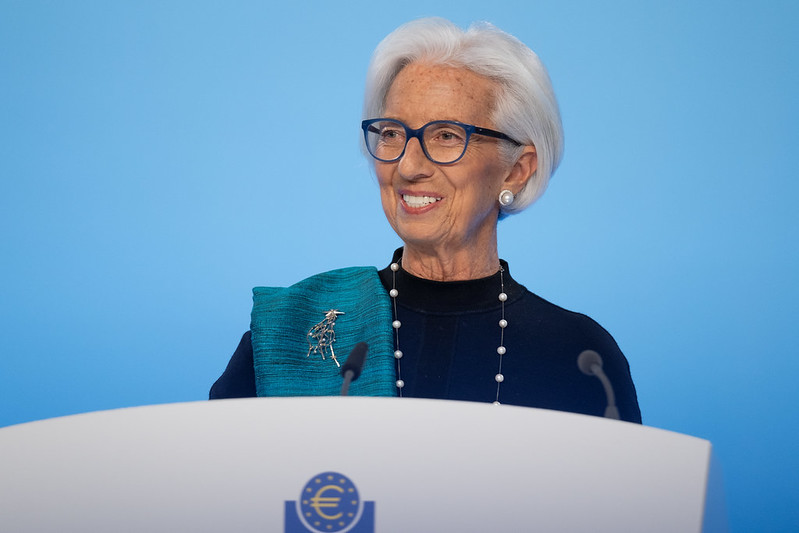
By David Barwick – FRANKFURT (Econostream) – Europe must develop its own artificial intelligence capacity to capture the technology’s economic gains without surrendering control over its data or becoming strategically dependent on foreign providers, European Central Bank President Christine Lagarde said Monday.
Building that capacity would require both faster investment in computing infrastructure and deeper European capital markets capable of directing more of the region’s savings toward domestic technology companies, Lagarde said at the “Hofburg im Dialog – Economy, Europe, Resilience” event in Vienna.
“I believe AI is that project,” Lagarde said, referring to the common European project she argued was needed to advance the region’s capital markets. “It needs capital on a scale that only markets can provide, and the stakes for Europe could hardly be higher.”
Lagarde said rapid adoption of AI offered Europe an opportunity to lift productivity as its workforce shrinks and governments face large investment needs. ECB estimates indicated that swift adoption could raise the level of euro area productivity by as much as 4% over the next decade, she said.
“AI is therefore arriving at the right moment,” Lagarde said. “After years of stalling productivity, it is the best chance we have to make the arithmetic work.”
European businesses were already moving quickly, with euro area firms expected to devote about 10% of their total investment to AI this year and more than half of euro area workers now using AI on the job, Lagarde said. But U.S. digital investment had risen twice as fast as that in the euro area over the past two years, while U.S. workers devoted two to three times as much of their working week to AI, she said.
Europe would also bear some of the financing cost of the U.S. investment surge even if it failed to obtain the corresponding growth benefits, Lagarde said. U.S. technology companies had issued more than $100 billion in bonds last year to finance AI investment, while higher U.S. long-term yields also influenced euro area borrowing costs, she said.
“But the case for speed may be even stronger than these estimates suggest, because Europe will pay for this boom whether or not it shares in the growth,” Lagarde said.
Simply purchasing foreign AI services would not resolve Europe’s problem, Lagarde said. The United States produced 59 notable AI models last year, compared with one each in France and the United Kingdom, and hosted 75% of global AI computing capacity, against Europe’s 5%, she said.
Lagarde identified data security, continued access and the ability to develop frontier applications as three reasons Europe needed domestic capacity. Almost half of the companies that had considered but rejected AI cited data protection concerns, while foreign suppliers could gain access to proprietary knowledge and potentially become competitors, she said.
Reliance on foreign providers could also give a trading partner influence over every sector of the European economy at once if access were restricted, Lagarde said.
“That is leverage of a kind no trade partner has ever held over Europe, and it could be used in any negotiation, on tariffs or on digital taxes, for example,” she said.
Lagarde said the risk presented Europe with a choice between restraining adoption and forgoing growth, or adopting quickly while accepting dependence and potentially losing the ability to run its economy according to its own values.
Europe therefore needed substantially more computing infrastructure, Lagarde said. Its data center capacity was already inadequate and the shortfall was expected to increase more than sixfold over the next decade, while closing the gap could cost as much as €600 billion, including the cost of chips, she said.
Lagarde said Europe should also develop models that were sufficiently capable for broad use and could run on European infrastructure. She said the region needed to preserve its position in critical parts of the AI supply chain, citing Dutch chip equipment maker ASML as an example.
“Some call this holding a chokepoint,” she said. “I prefer to see it as being a link in the chain that no one can afford to remove.”
Lagarde also acknowledged the possibility of an AI-related market correction. She said no one knew whether the investment surge would follow earlier technological revolutions that had been accompanied by sharp corrections. Because most European savers held their exposure to U.S. technology stocks through investment funds, those funds could be forced to sell into a falling market to meet redemptions, she said.
“Making sure our financial system can absorb that is a pressing task for supervisors and regulators,” she said, adding that banks supervised by the ECB were well capitalized.
Financing Europe’s AI ambitions would require a broader mix of funding and more patient equity capital because new business models could not rely on debt alone, Lagarde said. European households saved about €1.4 trillion a year, but Europe lacked sufficiently developed markets to channel enough of those funds toward its own strategic needs, she said.
“We hear a great deal about the savings and investments union,” Lagarde said. “This, fundamentally, is what it is for.”
Savings would continue to seek returns abroad, she said. “But Europe must first be able to deploy its savings at home.”