
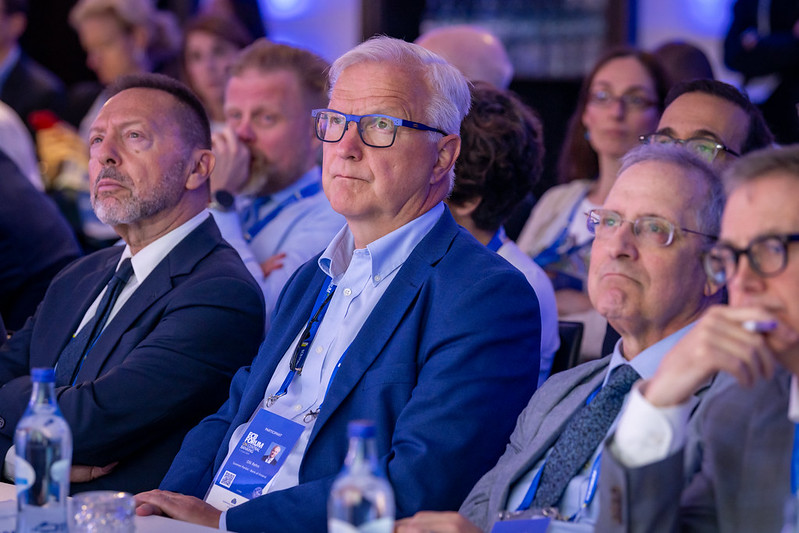
By David Barwick – FRANKFURT (Econostream) – European Central Bank Governing Council member Olli Rehn said Wednesday that euro area wage developments remained moderate and showed no strong evidence so far of second-round effects from the Middle East energy shock, while saying the Governing Council would reassess the inflation outlook at its September meeting.
"So far, wage growth and the wage outlook have remained moderate, with no clear signs of second-round effects," the Bank of Finland governor said in a speech at the OMFIF Nordic SSA Forum in Helsinki. "Keeping inflation expectations anchored will be essential to ensure this remains the case."
Rehn said the ECB was working to determine the correct monetary policy response to the oil and gas supply shock stemming from the Iran war and broader Middle East conflict.
"Designing the appropriate policy response to this supply shock is at the core of our work on the ECB Governing Council," he said. "We next meet in September to reassess the situation and outlook."
Rehn said euro area inflation had stabilized around 2% at the beginning of the year, when markets had expected the policy rate to remain around 2% for some time, before the Iran war severely disrupted the oil market and led to the closure of the Strait of Hormuz.
The disruption had trapped around one-fifth of global oil and LNG exports, as well as most spare production capacity, in the Persian Gulf, he said, warning that higher energy prices could raise inflation both directly and indirectly and generate second-round effects through wages and broader price-setting.
Rehn noted that the ECB had raised interest rates in June, while markets had begun pricing a more restrictive policy stance than before the conflict, and had kept rates unchanged in July while assessing the persistence of the shock and its possible indirect and second-round effects.
Turning to Europe's longer-term economic challenges, Rehn argued that a common European safe and liquid asset could help deepen capital markets, strengthen the international role of the euro, lower financing costs and improve monetary policy transmission.
Rehn acknowledged that the political and institutional obstacles to such an asset were formidable and that for some policymakers the idea remained a non-starter.
"But from the political economy perspective, and from the European standpoint, I won't say it is a no-brainer but certainly I would argue that the case for it is compelling," he said.
A sufficiently deep market in European safe assets could provide the foundation for more integrated capital markets, support the euro's international role and provide investors with a highly liquid asset carrying a convenience yield that could reduce European financing costs, Rehn said.
He said a larger supply of safe assets could also strengthen financial stability and make monetary policy transmission more effective by allowing changes in ECB policy rates to pass more smoothly through to market rates and the real economy. A common asset could additionally serve as a neutral pricing benchmark and an important source of collateral for repo and derivatives markets, he said.
Rehn said the euro remained the world's second-most-important currency but argued that its global role was constrained by Europe's fragmented sovereign debt markets, contrasting the roughly $30 trillion U.S. Treasury market with combined European public debt amounting to around one-third of that.
"The problem is fragmentation," he said, noting that German government debt was generally regarded as the euro area's principal safe asset but remained limited in supply.
Rehn said EU debt continued to be classified as supranational rather than sovereign debt, excluding EU bonds from some major sovereign bond indices, while uncertainty remained over the long-term role and scale of EU issuance. He cited an OMFIF survey showing that 55% of global public investors would increase their euro holdings if the EU became a permanent large-scale issuer.
Rehn said a European safe asset could help retain more European savings within Europe rather than allowing them to finance investment in the United States.
"Today, Europe helps finance that privilege," he said, referring to the benefits the U.S. derives from the global role of the dollar and Treasury market. "A European safe asset could help reduce that outflow, keeping more European savings in Europe to finance our own priorities."
Rehn said Europe faced what he called a "triple test" requiring greater responsibility for its own defense, diversification away from fossil energy alongside greater investment in renewables and nuclear power, and stronger productivity and competitiveness through investment, deeper capital markets, reduced regulation and innovation.
He said common European financing instruments could form part of the response, particularly given limited fiscal space in many EU countries, but stressed that any significant expansion would require sufficient and stable EU own resources, clear rules governing the use of funds, democratic accountability and sound national public finances.
"We cannot stand still, unless we are satisfied with our current irrelevance," Rehn said.