
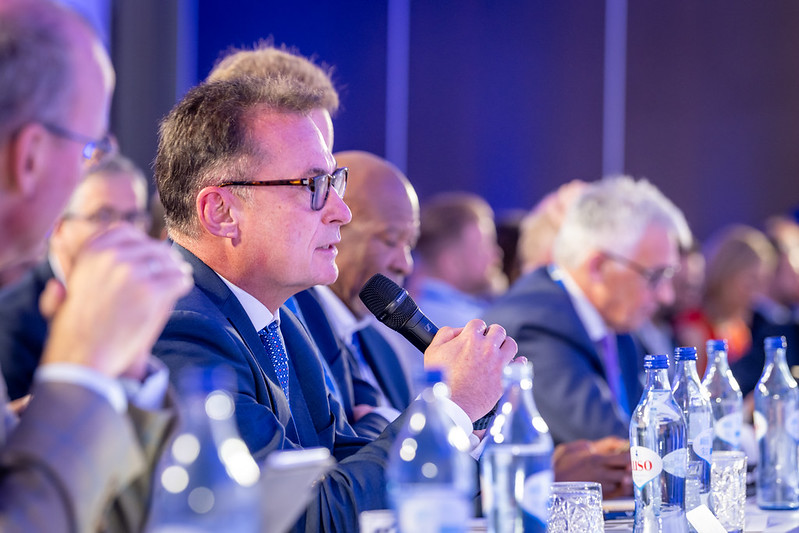
By David Barwick – FRANKFURT (Econostream) – European Central Bank Governing Council member Joachim Nagel on Tuesday urged Europe to move faster on the Savings and Investment Union and the digital euro, saying both were needed for a more sovereign and competitive Europe.
Nagel, who heads Germany’s Bundesbank, said in a speech in Frankfurt that from the perspective of a central bank, progress was especially important on the digital euro as the core of sovereign European payments and on the Savings and Investment Union as a driver of competitiveness.
“Now it is about taking action together,” he said.
Europe had high savings that could improve competitiveness if channeled more strongly into productive investment and innovative companies, Nagel said.
“The potential is there,” he said.
The EU had made progress toward a genuine Savings and Investment Union, but “more speed would be welcome,” he said.
Nagel welcomed the “One Europe, One Market” roadmap of the Council, Parliament and Commission and said many important projects should still be adopted this year.
These included a new 28th regime in company law, or “EU Inc.,” revised securitization rules and a broad legislative package on market integration and supervision, he said.
One core element of the package was a more centralized supervisory architecture for securities and non-banks, Nagel said.
The Bundesbank explicitly welcomed the initiative, while arguing for a proportionate design and adequate recognition of the role of central banks, he said.
“The European supervision of banks works,” he said. “The ECB and the supervisory authorities of the member states work together successfully.”
Nagel said the market integration and supervision package also included proposals on financial digitalization, such as the use of distributed ledger technology and the settlement of transactions in digital central bank money.
From the Bundesbank’s perspective, Europe could go further, for example with a 28th regime for digital securities, he said.
More uniform securities law would also be welcome in order to overcome national dividing lines in European financial markets, he said.
Progress on the Savings and Investment Union would make it more attractive for international investors to invest in EU countries and euro assets, thereby also strengthening the international role of the euro, Nagel said.
On payments, Nagel said Europe needed to remain capable of acting independently in a critical infrastructure area.
Large US companies dominated digital payments, and the trend toward digital payments combined with the lack of competitive European alternatives was strengthening incumbents such as Mastercard, Visa and PayPal, he said.
That created a dependency that could be “similarly risky” to dependencies in defense or artificial intelligence, Nagel said.
For Europe to act independently in payments, it needed its own digital ecosystem, he said. Digital central bank money could serve as the anchor of trust and stability in such an ecosystem.
Nagel said the Eurosystem wanted to offer digital central bank money both for transactions between financial institutions and for payments by citizens.
The digital euro should allow people to pay throughout the Eurozone, including in shops, online and among themselves, he said.
It should also provide infrastructure on which innovative private solutions could be built, giving such solutions direct European reach and making business models easier to scale, he said.
Trilogue negotiations between the European Parliament, Commission and Council began last week, Nagel said.
On the technical side, the Eurosystem was continuing its work, with a pilot phase due to start in mid-2027, he said.
“We are staying on course toward an introduction in 2029,” Nagel said.