
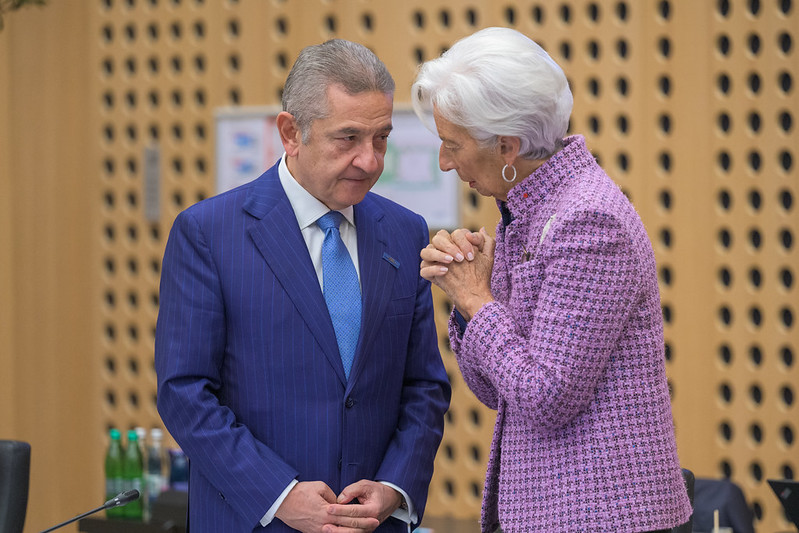
By Laura Contemori – ROME (Econostream) – European Central Bank Governing Council member Fabio Panetta said on Wednesday that the ECB would carefully assess energy markets, the economic outlook and wage and price dynamics when considering its future monetary policy decisions.
Panetta, who heads the Bank of Italy, said in a speech at the Italian Banking Association (ABI) annual meeting in Rome that monetary policy again had to strike “a delicate balance” as economic activity slowed and inflation remained above the 2% target.
The ECB Governing Council’s June 25bp rate increase had been “an initial and measured response” to the predominance of upside inflation risks, he said.
“When considering future decisions, the ECB Governing Council will carefully assess conditions in energy markets, and the evolution of the economic situation, of wages and of prices for goods and services,” Panetta said.
The aim was to keep inflation expectations “firmly anchored” and limit the indirect and second-round effects of shocks, he said.
Panetta said the global economy was in a period of transition shaped by two opposing forces: the Middle East conflict and the spread of artificial intelligence.
In the Eurozone, higher energy costs had compounded a situation already marked by low growth, while the contribution of AI to investment was more limited than elsewhere, he said.
Following an easing of tensions in recent weeks, the resumption of hostilities in recent days had been accompanied by further increases in oil and gas prices, confirming the fragility of the macroeconomic outlook, Panetta said.
Inflation was currently around 3% and expected to remain above that level until early 2027, he said.
Panetta warned that the speed of the recovery in financial markets required cautious interpretation, as it could indicate confidence in the global economy’s ability to absorb tensions but could also point to an underestimation of risks.
Risks linked to higher energy prices, tighter financial conditions and persistent geopolitical uncertainty appeared to be only partly incorporated into market valuations, he said.
The recovery in equity prices had been driven by optimism over AI, Panetta said. Demand for AI-related services had continued to expand rapidly, leading major technology companies to accelerate investment in IT infrastructure.
This had caused bottlenecks in advanced semiconductors, pushing up prices, producers’ margins and semiconductor stock prices, he said.
AI was bound to have significant effects on productivity and growth, but the timing and distribution of the benefits remained uncertain, Panetta said.
“Market resilience is a positive signal, but it is not to be confused with an absence of risks,” he said.
High valuations, gains concentrated in a few segments and persistent geopolitical uncertainty exposed markets to corrections that could be sudden, he said.
For investors, prudent exposure management was necessary, especially in sectors where optimism was most intense and prices incorporated particularly high earnings expectations, Panetta said.
On Italy, Panetta said banks continued to play a central role in financing the economy and had so far met higher corporate liquidity needs caused by the rise in energy prices.
In May, lending to firms accelerated to an annualized 6.2% on a three-month basis from 2.3% in February, he said.
Credit dynamics in the coming months would depend on the trajectory of the Middle East conflict, financial market conditions and banks’ risk perception, Panetta said.
A prolonged period of hostilities, together with renewed pressure on energy markets, could make banks more cautious and lead them to tighten credit standards, he said.
The Italian banking system remained robust, with high profitability, more than adequate capitalization and very good asset quality, Panetta said.
Non-performing loans had fallen from more than 8% of total loans ten years ago to 1% today, he said.
Looking ahead, Panetta said Italy needed more developed capital markets and adequate risk capital to complement bank lending and support innovation.
Italy had solid foundations, including a strengthened banking system, households with a high capacity to save and firms that had shown they could adapt in difficult circumstances, he said.
“The challenge is to transform these strengths into investment, innovation and sustained growth,” Panetta said.