
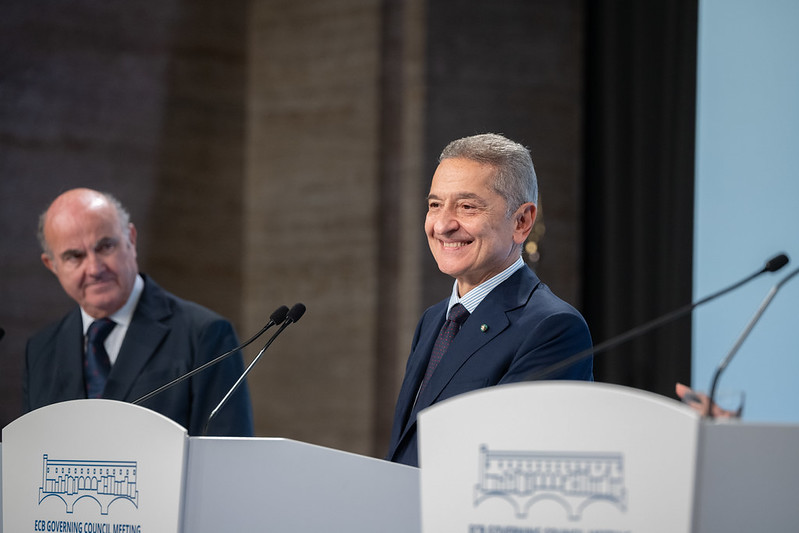
By David Barwick – FRANKFURT (Econostream) – European Central Bank Governing Council member Fabio Panetta on Monday said Europe had to complete the institutional architecture of the euro in order to strengthen monetary and political sovereignty in a more fragmented world.
Panetta, who heads the Bank of Italy, said in a speech in Rome that European monetary union had always been part of a broader political project, not just an economic arrangement.
Speaking at a workshop in memory of economist Robert Mundell, Panetta said Europe was again facing a crossroads as war, geopolitical rivalry and economic fragmentation reshaped trade, energy markets and strategic dependencies.
Artificial intelligence was creating major opportunities but also raising questions about productivity, inequality, security and sovereignty, he said.
“In this changing world, Professor Mundell’s work is not merely of historical interest,” Panetta said. “It helps us understand what gives a currency its resilience when economic power, technology and geopolitical influence are increasingly intertwined.”
The euro area had passed through two major waves of shocks since its creation, Panetta said.
The first, comprising the global financial crisis and the sovereign debt crisis, had exposed damaging fragmentation and placed the burden of macroeconomic stabilization entirely on monetary policy, he said.
By contrast, Europe’s response to the pandemic and the energy shock after Russia’s invasion of Ukraine had been “swift and coordinated,” with Next Generation EU complementing monetary policy and national measures cushioning households and firms, he said.
“The lesson was clear: when Europe acts with common purpose, it can advance its construction in ways that previously seemed impossible,” Panetta said.
Still, Europe now had to equip itself for a world in which security, technology, finance and monetary sovereignty were increasingly linked, he said.
This required progress on three fronts, Panetta said: reviving growth through reform and common investment, building a true savings and investment union, and completing the digitalization of Europe’s payment system.
Europe needed to strengthen innovation, deepen the single market and gain the scale required to compete in advanced technologies, he said.
Reforms would not be enough, he said, arguing that joint projects were needed in research, energy, decarbonization, digital infrastructure and artificial intelligence.
Panetta also called for simpler and more harmonized regulation in European capital markets, as well as a European safe asset jointly guaranteed by member states.
Europe could not finance innovation, the green transition and defense capabilities through fragmented national markets, he said.
On payments, Panetta said digitalization was now part of Europe’s monetary and political sovereignty, given that critical infrastructure had become an instrument of geopolitical pressure.
“Ensuring that central bank money remains available in digital form wherever payments take place - in retail and wholesale markets, domestically and across borders - is therefore part of Europe’s monetary and political sovereignty,” he said.
For retail payments, the digital euro would ensure that citizens continued to have access to central bank money in everyday transactions while strengthening Europe’s autonomy in a more divided and digital world, he said.
Panetta said Europe could no longer rely on slow, crisis-driven integration.
“We must shape our future before crises force our hand,” he said. “The euro, as Professor Mundell understood, is not merely a currency. It is a symbol of what Europe stands for: unity, sovereignty, economic prosperity, and the ability to defend the political values of freedom and openness.”