
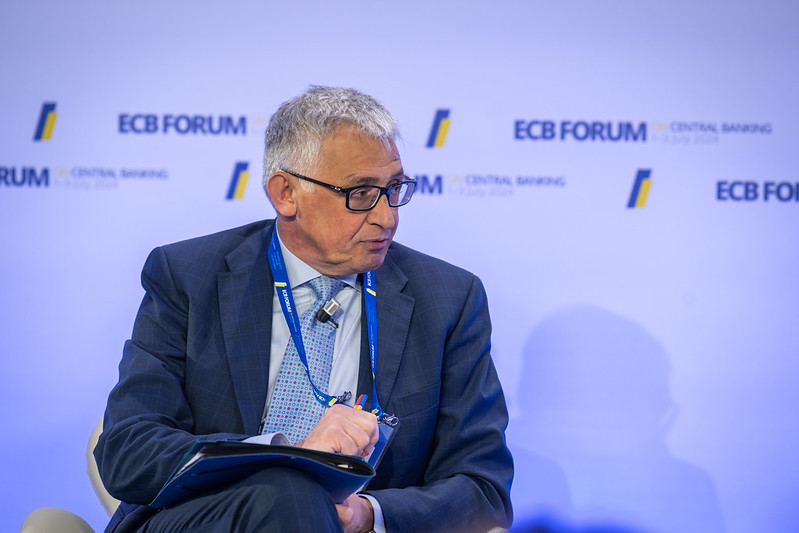
By Laura Contemori – ROME (Econostream) – European Central Bank Executive Board member Piero Cipollone said Friday that Europe urgently needed to reduce its dependence on foreign payment providers to safeguard its monetary sovereignty.
“In a fragmented world, we can no longer allow ourselves to depend on non-European solutions for a critical need like day-to-day payments,” Cipollone told a conference commemorating 80 years of the Italian Republic at Sapienza University in Rome.
International card schemes account for two-thirds of card transactions in the Eurozone, while 13 of its 21 countries lack a domestic card scheme, Cipollone said. Europe consequently has no digital-payment solution that works throughout the currency union in every situation.
The Eurosystem remained committed to ensuring the availability and acceptance of cash, he said, but more than one-third of everyday payments were for online transactions where cash could not be used.
The digital euro would provide a public European payment option for online and offline use throughout the Eurozone. However, the ECB would issue it only after the necessary EU regulation had been adopted.
Cipollone welcomed a recent political agreement in the European Parliament and the prospect of a vote in the coming weeks, while calling for the subsequent negotiations among EU institutions to be concluded quickly.
If the legislation is adopted by the end of 2026, the ECB intends to launch a pilot in 2027 and issue the first digital euro during 2029.
Co-badging with the digital euro would allow banks to provide payment services they cannot currently offer and extend their acceptance networks across Europe, Cipollone said. Its anticipated legal-tender status would create a pan-European network that banks and fintech companies could use without building new infrastructure or relying on international card schemes.
Turning to wholesale finance, Cipollone said Europe risked seeing the emerging tokenized-finance ecosystem developed elsewhere or become dependent on non-euro settlement assets unless it quickly provided settlement in tokenized central bank money.
Under its Pontes project, the Eurosystem was close to connecting commercial distributed-ledger platforms to TARGET services, with the new settlement service due to become available in the coming months. A blueprint for the longer-term Appia project is scheduled for 2028.
Cipollone also warned that dollar-denominated stablecoins could put pressure on the euro’s share of global export invoicing, which currently exceeds 40% and is broadly level with that of the dollar.
The Eurosystem was expanding links between its TARGET Instant Payment Settlement system and instant-payment systems elsewhere to facilitate cross-border transfers using the euro and participating countries’ currencies rather than third currencies.
TIPS already connects the Eurozone with Denmark and Sweden. A link with India’s Unified Payments Interface is due to become operational in 2027, Norway is expected to join in 2028 and Iceland has expressed interest. The Eurosystem is also exploring connections involving Switzerland, Brazil and Nexus Global Payments.
Although initially designed for domestic use, the digital euro could eventually facilitate cross-border transactions because its infrastructure could accommodate currencies other than the euro, Cipollone said.
Confidence in the currency remained high, with 82% of Eurozone residents saying they trusted the euro, he added.