
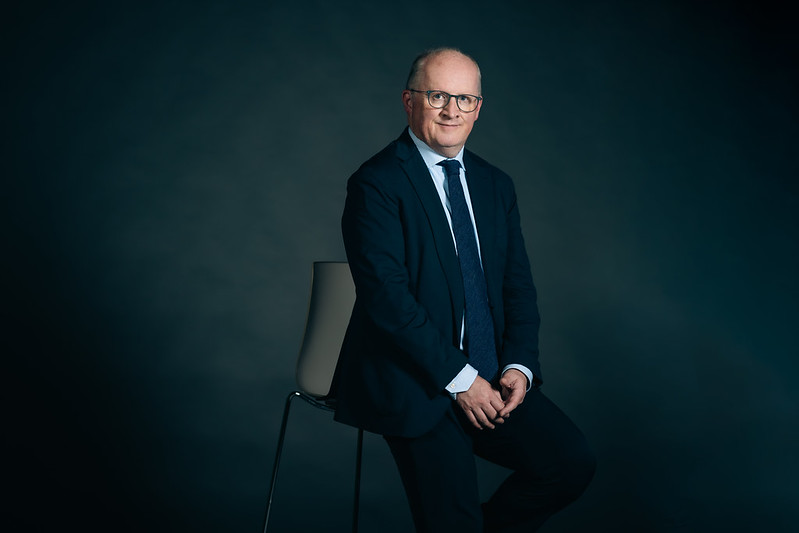
By David Barwick – FRANKFURT (Econostream) – European Central Bank Chief Economist Philip Lane said Tuesday that last week’s 25bp rate hike was a straightforward decision given the inflation outlook and the Eurozone economy’s resilience, but declined to say whether further tightening would follow.
In an on-stage interview with Reuters, Lane said the ECB’s decision to raise the deposit rate to 2.25% had followed a step-by-step analysis and was robust not only under the baseline but also under alternative scenarios.
Inflation was already above 3% and was expected to remain above that level for about a year, while the economy was taking a hit from the war in the Middle East but remained resilient, he said.
“There are other engines of growth in the European economy, and the financial system is also robust,” Lane said. “Then we felt that it was a straightforward decision.”
The hike was also justified under “a milder scenario” in which the war might be resolved more quickly, he said.
“[G]oing from 2.0% to 2.25% was a decision we felt was a safe decision under these different options,” he said.
Lane pushed back against comparisons with earlier oil shocks, saying oil was less important to the European economy than five years ago, owing partly to the greater role of renewables, hydro and nuclear power in the energy mix.
The war was partly an energy shock and partly an uncertainty shock, he said. “But if your mindset is going back to the 1970s on how oil shocks affect the economy, it is quite different now.”
The direct effect on inflation and economic activity was present but not as large as in the past, he said.
Lane said the ECB expected some increase in core inflation, though he said he preferred to look at non-energy inflation because energy also passed through to food.
Food accounted for about 20% of the index and should not be excluded, he said. The ECB expected indirect effects on food, goods and services this year and next, but not on the same scale as during the previous inflation episode.
“I do not think it is going to be like that,” he said. “But I also do not think it is going to be invisible.”
The latest oil shock was neither small nor enormous, he said. “It is a medium-sized shock, I think, is a fair description.”
Lane said the ECB was allowing for indirect effects in a contained way, but had not signaled a large tightening cycle.
“We did not announce last week, ‘We are going to go from 2.0% to 4%,’” he said. “We said we are going from 2.0% to 2.25%, and let’s see what we do in the future, depending on how the data flow.”
Asked about the Iran peace deal, Lane said it was welcome but still recent. Market pricing had moved only modestly, he said.
The oil forward curve was fairly flat for the next few years and remained close to current prices, he said. It did not imply a large return to pre-war levels, nor did it point to the much higher prices embedded in the ECB’s adverse and severe scenarios, he said.
Current market pricing was between the ECB’s baseline and milder scenario, and on a multi-year perspective closer to the baseline, he said.
Asked whether that implied the ECB would need to raise rates again if oil prices developed as futures suggested, Lane said he was “not really a big fan of answering highly conditional questions.”
Oil prices, geopolitical uncertainty and global AI developments would all need to be tracked before upcoming meetings, he said.
“There is a lot for us to track, and this is why it is not an empty phrase to say we will be data-dependent and meeting-by-meeting,” Lane said.
Further policy decisions would depend on whether incoming data increased or reduced concern about the ECB’s medium-term inflation target, he said.
The ECB would look at inflation figures, wages, supply-chain pressures and other indicators, Lane said.
“[I]t boils down, by and large, to a simple situation, which is basically if the balance of evidence gives us more concern about inflation versus if the balance of evidence gives us less concern about inflation,” he said.
Lane said the ECB did not have a unique view on how long it would take energy markets to normalize after a reopening of the Strait of Hormuz, but current market pricing appeared to reflect both time needed to restore supply and the need to rebuild inventories.
The episode would likely have a lasting impact on the transition toward renewable energy, he said.
“[E]ven if there is a durable peace here, the conclusion many will draw, not just in Europe but around the world, is: let’s not have that again,” he said.
On growth, Lane said the ECB’s limited downward revision to its June growth projections partly reflected a better starting point than previously assumed. The more relevant comparison was between the December, March and June projections, he said.
The ECB did think 2026 GDP was markedly lower than expected before the war, especially for consumption and investment, he said. But several factors were supporting the economy, including German fiscal expansion, a wider Eurozone deficit, recovering construction investment, rising real earnings, stronger world trade and resilient balance sheets.
“The resilience is not by magic,” he said.
Households and banks had strong balance sheets, and companies were not overleveraged, Lane said. Together with fiscal support, a neutral interest-rate starting point and global support from AI, these factors helped counterbalance the negative shock from geopolitics, trade, tariffs or oil.
Lane said geopolitical shifts were likely to create more volatility in the years ahead, even if the ECB did not take a view on whether this meant inflation would on average be higher or lower.
The ECB’s strategy review had put risk assessment at the center of policymaking, he said. This was why last week’s decision had been assessed not only under the baseline but across scenarios.
In an uncertain world, it would be a mistake to set out a path for rates over the next year, Lane said.
“We need to be agile,” he said. “We cannot lock ourselves into a policy path that would turn out to be irrelevant.”
The ECB would run monetary policy with a stabilizing role, Lane said.
“Our role is to stabilize inflation at around 2%,” he said. “If that requires us to move up on this occasion, we will continue to be, if you like, proactive in monetary policy and in line with how the risks evolve.”