
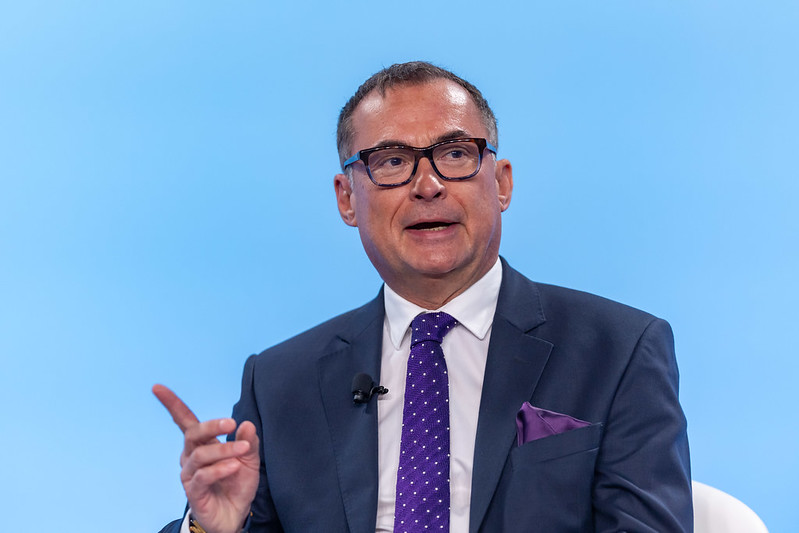
By David Barwick – FRANKFURT (Econostream) – European Central Bank Governing Council member Joachim Nagel said Monday that last week’s 25bp rate increase had been warranted by a worsening inflation outlook and that the ECB would keep its options open at its July meeting.
Nagel, who heads the Deutsche Bundesbank, said in a speech at the Frankfurt Euro Finance Summit that Eurozone monetary policy was not facing “a short-term supply shock that we can look through without action.”
The war in the Middle East and the monthslong blockade of the Strait of Hormuz had sharply raised energy prices, especially crude oil, with implications for broader inflation, he said.
Eurozone HICP inflation had risen from just under 2% at the start of the year to a preliminary 3.2% in May, he said. While this had so far been driven largely by energy, prices of other goods and services had also recently increased.
According to the Eurosystem’s June projections, the inflation outlook had worsened, Nagel said, with high energy costs expected to feed increasingly into consumer prices in the months ahead.
“Second-round effects also cannot be ruled out at present,” he said. The risk of high wage demands pushing prices higher was currently “rather low,” but second-round effects could also arise if inflation expectations increased, he said.
Market-based inflation expectations had recently risen, and the ECB’s consumer survey had shown clearly higher inflation expectations in March and April, he said. Eurosystem staff now expected inflation to average 3.0% this year and to return to the 2% target only in 2028, he noted.
“Against this background, we decided in the ECB Governing Council last Thursday to raise the key interest rates by 0.25 percentage point,” Nagel said. “We are determined to set monetary policy in such a way that inflation stabilizes at the 2% target over the medium term.”
The ECB’s Governing Council would next meet on monetary policy in July, he said. “We are keeping all options open.”
The rate step decided last week had been expected by financial markets and “should not have surprised anyone,” Nagel said.
“The level of interest rates is currently still largely neutral,” he said. “The basic monetary policy stance is therefore currently neither weighing on the economy nor impeding structural measures for stronger growth.”
Turning to Germany, Nagel said the Middle East war had only slightly dampened the country’s 2026 outlook because the winter half-year had been stronger than expected.
The Bundesbank now expected German real calendar-adjusted growth of 0.5% this year, only 0.1 percentage point less than in its December forecast, he said. Without calendar adjustment, growth would be 0.7%, reflecting an above-average number of working days.
Growth was expected to accelerate to 0.8% in 2027 and 1.4% in 2028, supported by lower energy prices, a strengthening global economy and fiscal policy impulses, especially higher defense spending and infrastructure investment, he said.
Nagel also called for giving investment priority in Germany, including through additional public infrastructure investment, faster planning and approval procedures, digitalization of public administration and stronger venture capital markets.
Germany’s venture capital market remained much smaller than those of other advanced economies relative to economic output, he said. In 2025, venture capital deal volume amounted to 0.16% of German GDP, compared with almost twice as much in France, nearly four times as much in the United Kingdom and more than five times as much in the United States.
European venture capital funds were too small, Nagel said, with only 5% of capital raised worldwide by venture capital funds coming from the EU.
“It is high time to address these deficits politically,” he said. “Europe’s financial markets must grow together. We need a genuine single market for capital.”