
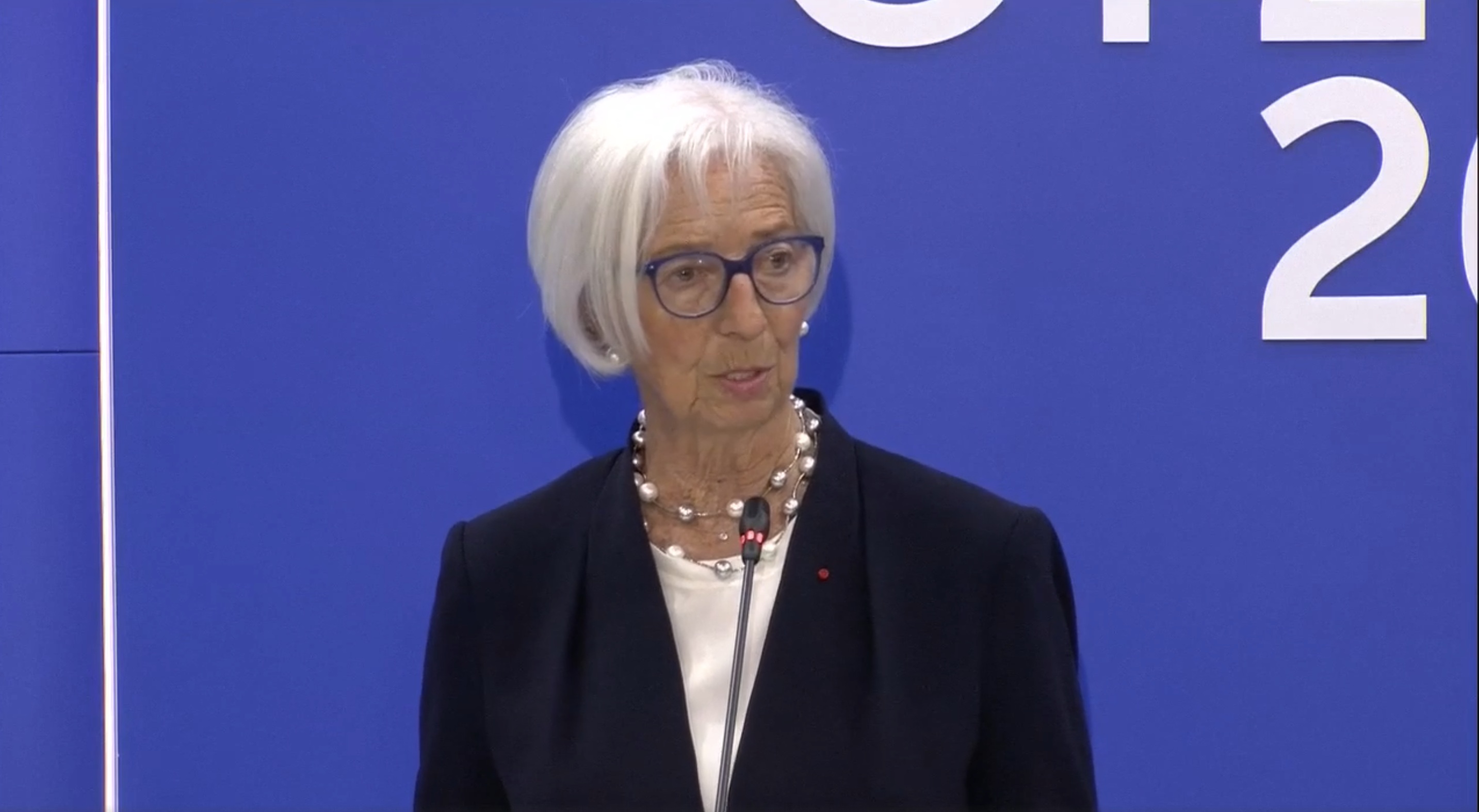
By David Barwick – FRANKFURT (Econostream) – European Central Bank President Christine Lagarde said Monday that the digital euro would help Europe reduce its reliance on foreign-owned payments infrastructure and give the region a payment instrument usable across the whole currency area.
In an opening speech at an ECB conference on money and payments, Lagarde said technology and geopolitics were creating new challenges for Europe, with tokenization changing how money and securities are exchanged and ownership of financial infrastructure becoming “an instrument of power.”
“Real as these challenges are, for Europe they are above all an opportunity,” she said, arguing that capital markets and retail payments could both benefit from less fragmentation and greater competition.
In wholesale markets, a single cross-border transaction currently moved through multiple separate record-keepers, with 32 central securities depositories in the European Union compared with two in the United States, she said.
Tokenization could help overcome this by allowing ownership and payment to be recorded and settled on a shared ledger, Lagarde said.
But tokenized finance would not develop at scale without central bank money, she said. “Without a credible, risk-free asset to settle in, tokenized finance will splinter into private islands and fail to reach escape velocity from its current sandbox status.”
Market participants had made clear that they would not issue digital assets at scale until they could settle in central bank money, she said.
“Nothing else is trusted and accepted by all, and nothing else can expand and contract with the market’s needs so that liquidity is there when the system most needs it,” Lagarde said.
The Eurosystem’s Pontes project would settle tokenized transactions in central bank money already this year, she said. Its Appia project would go further by drawing up a blueprint with the market for a single European market in tokenized finance.
Turning to retail payments, Lagarde said the Eurosystem remained committed to preserving cash, with a new series of euro banknotes planned. But as more activity shifted online, the digital euro would preserve Europeans’ access to public money, she said.
“The digital euro does more than preserve what we have,” she said. “It is also a chance to end a dependence we have lived with for too long.”
Europe had no pan-European card scheme of its own, and more than 60% of card payments relied on international schemes, Lagarde said. Thirteen of the 21 Eurozone countries had no national card scheme, she said.
Because the digital euro would have legal tender status, it would have to be accepted everywhere, giving Europe a payment instrument usable across the currency area, she said.
“For the first time, European players could compete on equal terms,” Lagarde said.
On cross-border payments, Lagarde said sending money abroad remained slow and costly, while US dollar-denominated stablecoins were positioning themselves to fill the gap.
It was still unclear whether stablecoins would remain faster and cheaper once full costs and compliance standards were taken into account, she said. Still, “[t]he gap is there and the case for action is clear.”
The Eurosystem was responding by linking its TIPS instant payment system with others, she said. A connection to India’s UPI was being built, while links to the Nexus Global Payments network in Southeast Asia and Switzerland’s SIC IP system were in advanced analysis.
The aim was for Europeans to transfer money to more countries “in seconds, on rails of their own,” Lagarde said.
The euro’s international role had long been held back by the same fragmentation that limited Europe domestically, she said. A deeper and more integrated market anchored in public money was “the path to a currency the world will want to use.”
Lagarde said the Eurosystem could not deliver the vision alone, calling on the market to invest in technology and agree on common standards.
Governments also needed to provide legal certainty through a common framework for digital assets, she said. Without that, Europe risked rebuilding in law “the fragmentation that technology is currently dissolving.”