
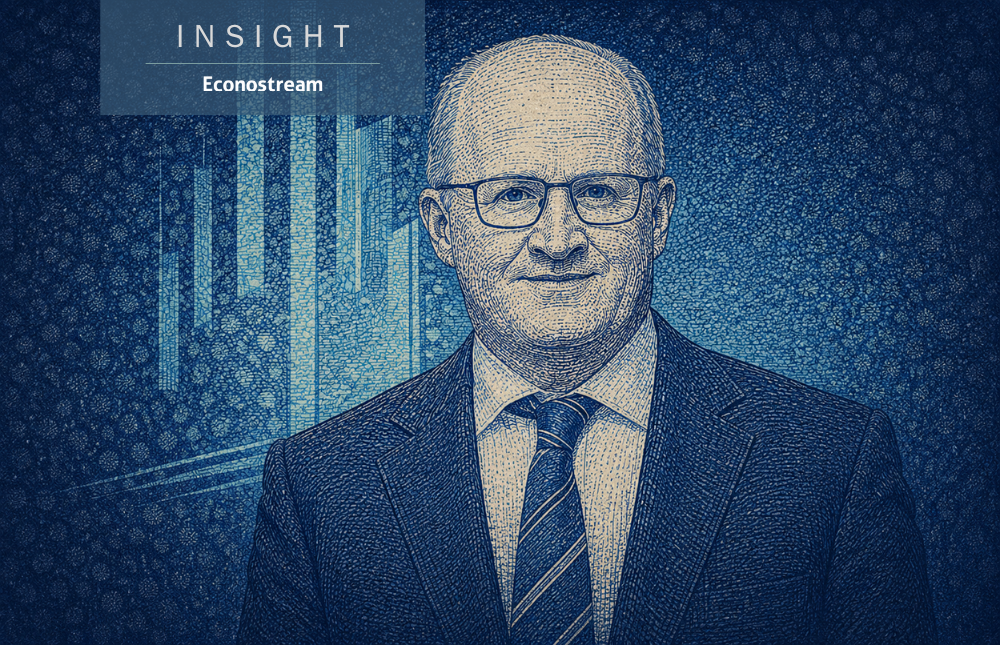
By David Barwick – FRANKFURT (Econostream) – European Central Bank Executive Board member Isabel Schnabel may have made the strongest official case yet for a June rate hike, but Chief Economist Philip Lane has now made clear that one move would not imply another.

To be sure, Schnabel stayed well within the ECB’s meeting-by-meeting framework. Yet the difference in tone between the two interviews is unmistakable. Her interview made the June case as forcefully as possible without formal pre-commitment; Lane’s Nikkei interview seemed designed to prevent that case from justifying post-June assumptions.

Whereas she declared that looking through the shock was “no longer an option,” and that even an immediate end to the war would probably not obviate a monetary policy response, Lane hewed to the ECB’s graduated framework: a small, temporary shock can be looked through; a persistent but medium-sized shock may require some response. Only if the shock becomes large and broadens out in a nonlinear way would a stronger response be needed.

Asked where the current situation fits, Lane merely said the Governing Council was still assessing the size of the shock, while acknowledging that the longer the conflict continued, the less plausible the benign scenario became.

This is not new for Lane. In his May 13 and May 22 speeches, he had already stressed that energy shocks can prolong inflation by working through production networks and expectations, but also that the policy response is not mechanical and depends on whether higher relative prices turn into broader inflation dynamics. The Nikkei interview continues that line: alert to the June risk, but reluctant to let one possible move become a path.

That is materially less forceful than Schnabel’s formulation. It points in the same direction for June, but with less enthusiasm and more concern about what markets infer next.

The simultaneity of the two interviews may not be coincidental. Moreover, with Banque de France Governor François Villeroy de Galhau on his way out, Lane is the most important figure able to articulate the case for restraint from inside the ECB leadership: not a case against action if the threshold is met, but a case against turning one move into a path before the data justify it.

That reading is reinforced by Lane’s repeated insistence on no pre-commitment. “In a world of uncertainty, we do not pre-commit,” he said. If the ECB hikes in June, then July, September and subsequent meetings will still depend on the incoming data, he said.

“I don’t think we need a complete vision for the future by June, because the vision for the future will depend on the incoming data,” he said.

The difference between saying the shock has already become persistent enough to justify a response and saying that a response to a persistent but medium-sized shock can still be limited is meaningful, but not a contradiction. Depending on developments, the gap could yet widen.

For now, Lane may even better fit our own view: a June hike now looks virtually unavoidable, an assessment he said nothing to resist, but it remains premature to infer a sequence of moves. At the heart of this sits the recognition that policymakers are anything but delighted about raising borrowing costs when the economy is already weak.

Lane’s interview, even more than Schnabel’s, thus backs our view that a June hike should be read as an insurance move against persistence and pass-through. Anything else still has to be earned by the data.