
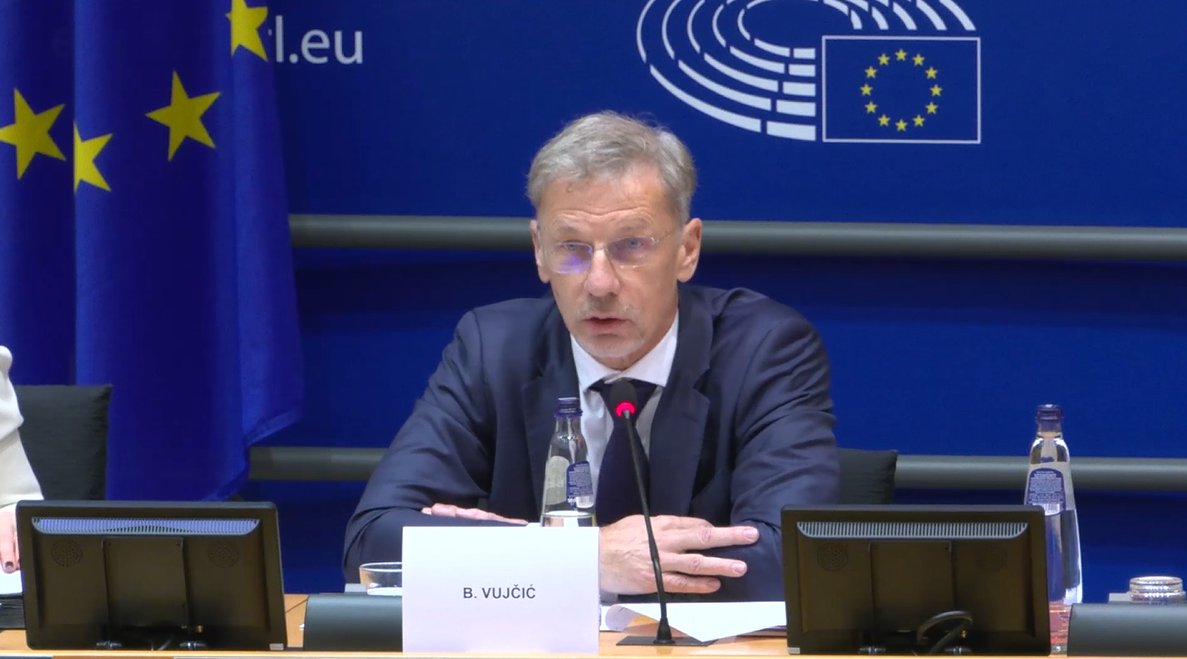
By David Barwick – FRANKFURT (Econostream) – Reducing internal barriers to goods and services by just 2% could in the long run offset the projected roughly 0.7 percentage point hit to euro area GDP from higher U.S. tariffs between 2025 and 2027, European Central Bank Vice President Boris Vujčić said Monday.
“Reducing internal barriers to goods and services by just 2% could, in the long run, offset the projected impact of higher US tariffs on euro area GDP, estimated at around 0.7 percentage points between 2025 and 2027,” Vujčić told the Central Bank of Ireland’s Financial System Conference in Dublin.
Europe should respond to a world increasingly shaped by geopolitical fragmentation not by retreating from openness but by strengthening integration and resilience, Vujčić said.
“My answer in a single sentence is: not by retreating from openness, but by building the resilience that allows this openness to endure,” he said.
Internal fragmentation remained a major impediment, with national rules, standards and procedures acting like internal tariffs equivalent to around 67% for goods and 95% for services according to ECB estimates, Vujčić said. Cross-border equity market frictions within the euro area had fallen by around 12 percentage points since 2014, compared with around 25 percentage points between the euro area and the United States, he said.
“Strikingly, we are integrating faster with the United States than with each other,” he said.
The lack of integration also reduced Europe’s capacity to absorb shocks, Vujčić said. Around 70% of state-level output shocks in the United States were absorbed through markets and fiscal transfers, with capital markets doing most of the work, compared with around 30% in the euro area and only 5% to 10% through capital markets, he said.
ECB research also showed that European firms cut investment in response to higher oil prices while U.S. firms did not, and that European companies most exposed to the Covid-19 shock with predominantly domestic shareholders cut investment 20% more than peers with an international shareholder base, he said.
“In a fragmented Europe, investment becomes the margin of adjustment whenever a shock hits,” Vujčić said. “That is a resilience problem before it is a growth problem.”
For the financial sector, the savings and investments union should encompass both banking union and capital markets union, with cross-border banking groups able to operate across the euro area “as though it were a single jurisdiction,” Vujčić said.
That required completing banking union with a European deposit insurance scheme, backed by a sound crisis-management framework, as well as more harmonized creditor hierarchies and insolvency rules, he said. Europe also needed a genuinely integrated capital market, including harmonized withholding taxes, he said.
Vujčić also called for resilient European payments infrastructure, saying the digital euro would reduce dependence on non-European retail payment providers while the Pontes wholesale digital-payments initiative marked another step toward greater autonomy.
“The geopolitical environment is unlikely to become any easier,” Vujčić said. “But how well we absorb the shocks we face depends very much on the choices we make.”