
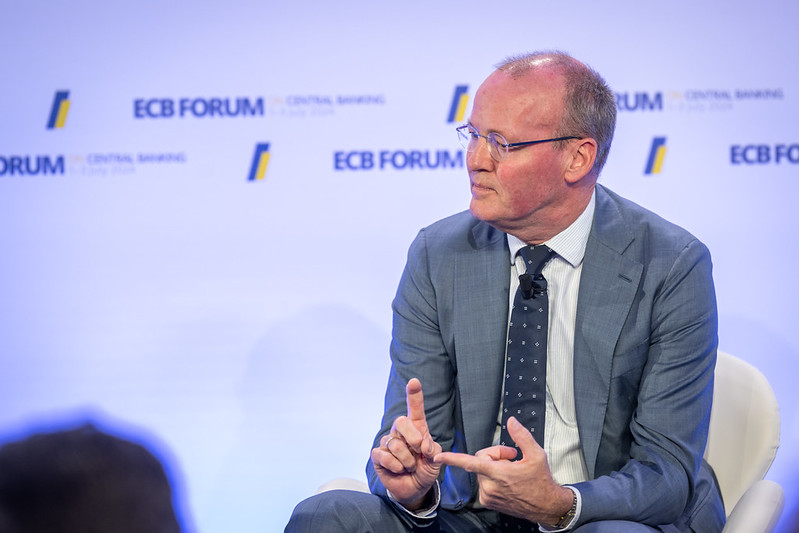
By David Barwick – BANGKOK (Econostream) – Former European Central Bank Governing Council member Klaas Knot said Friday that the ECB was pursuing the appropriate monetary policy in the face of the latest supply shock, arguing that policymakers should do what was necessary to contain inflation while avoiding an unnecessarily large hit to growth.
“I think they’re doing exactly what they need to do,” Knot said during an Institute of International Finance panel discussion in Bangkok. “If I were still part of the Governing Council, I would not have advocated any other sort of policy approach than the one currently taken.”
Negative supply shocks were particularly difficult for central banks because they simultaneously raised inflation and weakened activity, Knot said, cautioning against assuming that policymakers could simply look through them.
“Reality has taught me that there are very few of these shocks so clean that you don’t have to take into account the likelihood of second-round effects,” he said. “So, typically the central bank will have to respond.”
However, policymakers also had to recognize that an overly forceful response would aggravate the growth damage from the shock, he said.
“You have to, as a central bank in cases like that, do what is necessary, but as little as possible,” Knot said.
The key was to ensure that medium-term inflation expectations remained anchored around the ECB’s 2% target, he said. The credibility accumulated by the ECB through its response to the 2022-23 inflation shock gave it more room to limit the scale of its response now, he said.
“That credibility can then help to maintain the anchoring properties of inflation expectations, and that means that you can afford to do a little less than you would have had to otherwise to do if you lacked the credibility,” he said.
Knot said the definition of the medium term should not be rigid. In the face of a negative supply shock, the ECB could allow somewhat more time for inflation to return to target so long as expectations remained anchored.
“In the face of negative supply shocks, you actually want to use the flexibility of extending the medium term a little bit if you can, as long as it doesn’t affect your credibility, as long as inflation expectations don’t sort of drift away from your target,” he said.
He said forward guidance on future interest-rate moves was less useful in the present environment than during the period of very low inflation and rates, when risks had been overwhelmingly one-sided.
Rather than signaling future rate decisions directly, the central bank should be transparent about its assessment of the economy and inflation outlook, he said.
“Rather than communicating on what could be the potential future steps, I do think you have to be quite extensive and quite transparent about your views on the economy,” Knot said.
On sovereign debt, Knot said current market conditions did not amount to a crisis and that there was presently no role for the ECB in addressing the rise in borrowing costs associated with fiscal fundamentals.
“If you look at debt levels, there is absolute reason for concern,” he said, noting that the primary-balance adjustments required to stabilize debt ratios in countries including the US, UK and France amounted to several percentage points of GDP.
But he rejected describing current conditions as a crisis.
“Crisis is too big a word,” Knot said. France in particular benefited from a strong private-sector savings position and was therefore not a twin-deficit economy, he said.
Still, “the situation with the French fiscal is clearly not sustainable,” Knot said, adding that there was no agreement among France’s main political parties on how the required consolidation should be achieved.
“It is a problem, but it is too early to sort of already talk about a crisis. It’s not beyond repair,” he said. “It can be done, but it needs work and it needs commitment and effort.”
Where higher sovereign borrowing costs reflected deteriorating fundamentals, the central bank should not intervene, Knot said.
“The borrowing costs can only be brought down in a situation like that by addressing the problem at the root where it is, and that is by addressing these fiscal imbalances themselves,” he said.
The ECB did have a responsibility to preserve the homogeneous transmission of monetary policy across the euro area, but current spread movements were neither widespread nor disorderly, he said.
“We’re not in the situation where there is a role for the central bank at this moment,” Knot said.
He also warned against allowing concerns about sovereign borrowing costs to constrain interest-rate policy, saying the danger of fiscal dominance should not be exaggerated.
If a central bank refrained from raising rates despite an inflation outlook warranting tighter policy, longer-term yields could rise instead as inflation expectations and risk premia increased, potentially inflicting even greater damage on government borrowing costs.
“The risk of fiscal dominance should not be overplayed, because giving into it is not attractive for those who want lower borrowing costs either,” Knot said.
Knot said geopolitical and geo-economic risks remained underpriced by financial markets, pointing in particular to rising cyber threats and conflicts that appeared to be escalating rather than moving toward resolution.
“I still think that markets have difficulty pricing geopolitical and geo-economic risks,” he said. “I worry about these conflicts in the world that we can’t seem to be anywhere close to a resolution.”
His broader concern was that geopolitical tensions were eroding the international rules-based order and weakening the willingness of countries to cooperate on problems that crossed national borders and could not be solved by individual jurisdictions alone.
“That is probably my main worry,” Knot said.
- The author of this story can be contacted at david.barwick@econostream-media.com