
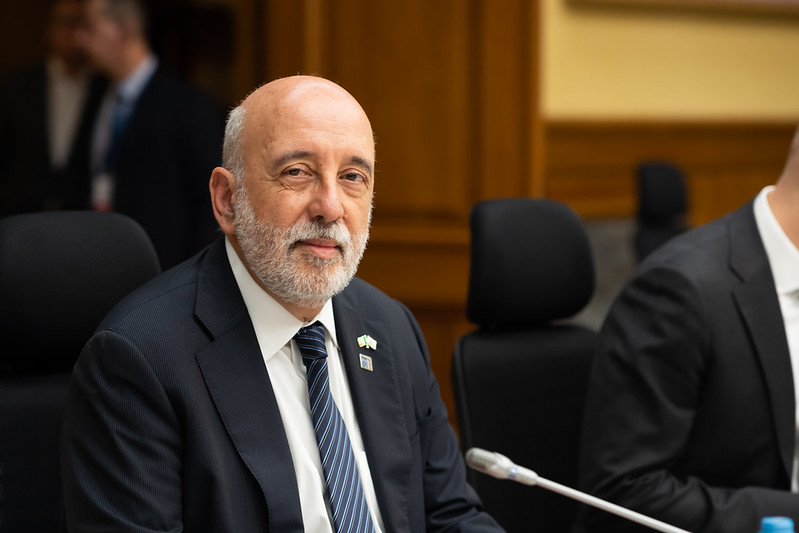
By David Barwick – BANGKOK (Econostream) – European Central Bank Governing Council member Gabriel Makhlouf on Wednesday called for the creation of a single European safe asset, saying the case for it was clear despite the political difficulty involved.
The Central Bank of Ireland governor, speaking at an Institute of International Finance panel discussion in Bangkok, said completing Europe’s banking and capital markets architecture required governments to move beyond repeated diagnoses of what needed to be done.
“We also need — and this is politically much more challenging — a single safe asset in Europe,” Makhlouf said. “And it’s a no-brainer. We should just get on and do it.”
Makhlouf said the same applied more broadly to banking union and the development of a single capital market.
“When we talk about a single capital market, we’ve been talking about banking union — these are just things we all know,” he said. “We should just do them. Just get on with it.”
Makhlouf said Europe’s broader economic potential depended in large part on removing barriers it had itself created within the single market.
“The single market in goods, the single market in services and the single market in capital — all of them have got internal barriers that Europe has built over the years,” he said.
“Fixing our single market in goods, in services and capital will actually release opportunity and create potential,” Makhlouf said.
Services represented a particularly large missed opportunity, he said, given their importance for employment and the remaining obstacles to cross-border activity.
“Most of our employment in Europe is in services,” Makhlouf said. “And yet intra-EU services trade — I mean, that’s a tragedy really. There’s huge potential there and we have created barriers within Europe.”
He said Europe should also remove obstacles that made it difficult for professions and employees to operate across national borders.
“What I hear from businesses who want to move employees from Dublin to Madrid is that it’s horrific,” Makhlouf said, citing differences in pension and social-security arrangements.
At the same time, Europe should preserve the openness that had underpinned its economic model and resist the shift toward greater closure visible elsewhere in the world, he said.
“I think the number one lesson is to be an open economy, to avoid the temptation, which we’re seeing elsewhere in the world, of becoming more closed,” Makhlouf said.
“Keep the openness that you have really founded your economy on,” he said, urging Europe to continue developing links with the rest of the world through free-trade agreements, payment-system connections and stronger multilateral institutions.
Makhlouf also said Europe should “prioritize fixing itself,” arguing that repeated reviews had already made clear what reforms were needed.
“We’ve had endless reviews telling us what needs to be done, and we just need the political will to do it,” he said.
Despite the obstacles, Makhlouf said he remained positive about Europe’s ability to advance further, noting that the European Union consisted of 27 countries with different traditions, perspectives and cultures.
“We are not one single country. We are many working together,” he said.
“It’s all about choices,” Makhlouf said. “Governments can choose whether to realize that potential or not.”