
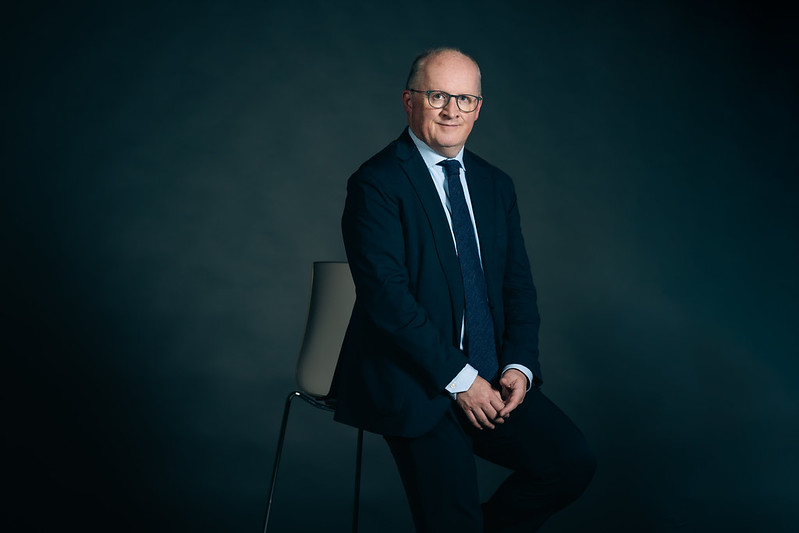
By David Barwick – FRANKFURT (Econostream) – European Central Bank Chief Economist Philip Lane on Tuesday said higher long-term interest rates would weigh on euro area growth and inflation and would therefore form part of the assessment determining where the ECB’s policy rate needed to go, while the energy shock remained the dominant driver of interest rate policy so far.
In an interview with Italian news agency ANSA conducted on October 1, Lane said the recent increase in long-term rates, particularly when driven by external global factors rather than European developments, “slows down the European economy and, on its own, reduces the inflation rate.”
That effect would be considered alongside the inflation and risk analyses “in determining where we need to go with the policy rate,” Lane said, adding that broader financial conditions, including long-term rates, were an important input into monetary policy decisions.
Lane said the ECB would examine the latest increase closely through its bank lending survey and surveys of firms to determine its effects on investment and employment decisions.
“[W]e are very data-dependent and we will be studying this trend in the financial data very closely,” he said.
At the same time, Lane said the recent tightening in monetary policy had primarily reflected the inflationary consequences of the Middle East energy shock rather than the resilience of economic activity.
“The main driver of the interest rate decision has been the inflation implications of the energy shock,” he said.
Energy prices were clearly above the level assumed in the ECB’s baseline projections, Lane said, but it would be too simplistic to conclude that the economy had moved into one of the ECB’s alternative scenarios because those scenarios incorporated several assumptions, including the strength of second-round effects.
Lane said the ECB had so far not seen “very strong second round effects,” while the extent to which higher energy prices would pass through to the wider economy remained uncertain.
The recent renewed increase in energy prices and uncertainty over the duration of the Middle East conflict meant the ECB would have to assess whether the resilience of economic activity seen over the summer would continue, Lane said.
“The dominant issue in terms of interest rate policy so far has been the energy shock,” he said. The economy’s resilience meant that a downside risk to activity that could have materialized had so far failed to do so, he said.
Lane said fiscal policy had also supported activity this year, citing Germany’s infrastructure and defense program and relatively strong public investment in countries including Italy under the final year of Next Generation EU.
With the NGEU program ending this year, however, fiscal support to the economy in 2027 and 2028 would differ from that provided in 2026, he said. AI-related investment was providing an additional source of economic support, although on a smaller scale than the investment boom in the United States, Lane said.
Lane also cautioned against broad fiscal measures intended to shield households from higher prices. Governments should provide targeted support to lower-income households, he said, because broad-based support would increase aggregate demand and hinder the return of inflation to target.
“Having a very general, widespread fiscal expansion is not going to help,” he said.
On wages, Lane said the ECB’s September projections foresaw Italian wages growing faster than inflation in 2027 and 2028, allowing some recovery in living standards after workers failed to receive full compensation for this year’s inflation increase.
However, he said excessive wage growth could damage competitiveness and discourage foreign investment and hiring, while Europe’s status as a large net energy importer meant the economy as a whole could not be fully insulated from the loss associated with higher energy prices.
Lane said the ECB needed to adjust interest rates in either direction to keep inflation around its 2% target, recalling that rates had previously been raised when inflation was too high and subsequently lowered as inflation pressures eased.
“If the inflation rate remained at 3 or 4%, that would be very damaging for the Italian workers, Italian households,” he said.
Turning to public finances, Lane said governments needed to take account of the higher long-term interest rates they were likely to face over the coming years rather than focus only on their immediate budget horizon.
Higher borrowing costs reinforced the importance of raising potential growth, he said, making the reforms proposed by Mario Draghi and Enrico Letta still more important in a high interest rate environment.