
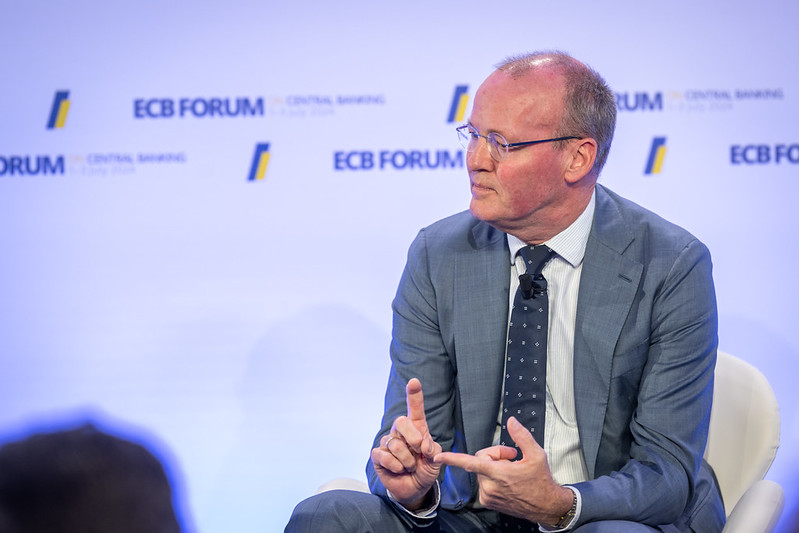
By David Barwick – VIENNA (Econostream) – Former De Nederlandsche Bank President and Financial Stability Board Chair Klaas Knot warned Monday that the rapid growth of non-bank financial intermediation was generating mounting financial stability risks, while saying implementation of measures intended to address them remained “poor” across jurisdictions.
Speaking at the Oesterreichische Nationalbank, Knot said NBFI had grown to account for more than half of global financial assets, while stressing that the sector also brought important benefits through broader access to finance, diversified funding sources, stronger competition, improved pricing, enhanced financial services and innovation.
“On the other hand, we have to admit there are some serious financial stability concerns associated with NBFI,” he said.
Knot highlighted liquidity mismatches, hidden leverage and liquidity pressures arising from margin and collateral calls among the principal vulnerabilities, while his presentation also pointed to disruptions in core bond markets and growing bank funding of private credit as signs of increasing fragility.
He drew particular attention to the use of very low haircuts in leveraged positions, saying around 70% of relevant U.S. dollar transactions were being conducted at zero haircut, compared with about 55% in Europe. Much of the associated risk-taking was concentrated among a relatively small number of large hedge funds, he said.
“They move fast into these assets, but they might move fast out of these assets,” Knot said.
Private credit was another area of concern. Knot displayed a chart entitled “Private Credit: Canary in the Coal Mine?” showing a widening divergence since the beginning of 2025 between the market capitalization performance of JPMorgan and that of several large alternative asset managers, including KKR, Blue Owl, Ares and Blackstone.
“Since January 1st, 2025, there is actually a notable divergence,” he said.
“So apparently the market is also worried about something,” Knot said, linking the divergence to increasing awareness of the potential drawbacks of private credit.
He described procyclicality as a “big risk” in the sector and warned that shifting lending activity away from regulated banks did not necessarily eliminate the underlying problem.
“There is a risk that we sort of push out this procyclicality of banks and it will come through the back door of private credit,” he said.
Knot’s presentation argued more broadly that the rise of NBFI could amount to a transformation of financial risk rather than a simple migration of risk away from banks.
While credit risk could increasingly be warehoused by nonbanks, liquidity risk could remain with banks through credit lines, he said, with banks retaining advantages from deposit funding and access to central bank facilities.
Knot also stressed the growing interconnectedness between banks and non-bank financial intermediaries. He noted the substantial bank exposure to NBFI and argued that the links between the two sectors had become increasingly widespread.
A slide reviewing the Financial Stability Board’s work on NBFI resilience listed measures covering money market funds, liquidity in open-ended funds, preparedness for margin and collateral calls, leverage and data gaps, but Knot highlighted the comparatively limited attention paid to interactions between banks and nonbanks.
“There are many areas where we just have to step up the efforts and that is encouraging,” he said, while making clear that important parts of the agenda still required substantially greater effort.
Knot recalled that, in letters to the G20 while he was still an official, he had described implementation of agreed measures across jurisdictions as “uneven.”
“Now that I’m not an official,” he said, he could instead describe implementation as “poor.”
The policy agenda presented by Knot called for system-wide stress testing, minimum and potentially procyclically adjusted haircuts and initial margins, stronger oversight of bank exposures to NBFIs and better data quality, access and disclosure.
He also advocated stronger institutional infrastructure and closer attention by regulators to systemic risks, while calling for greater burden-sharing between private and public sectors in recovery and resolution.
For periods of market stress, Knot called for effective, broadly accessible international liquidity facilities and swap lines for major currencies and, where necessary, contingent liquidity facilities for some types of NBFI accompanied by tight regulation and oversight.
He also called for policymakers to avoid open-ended asset purchases and to communicate clearly when using monetary policy tools for financial stability purposes. Monetary and financial stability policy conflicts should be addressed through careful design of the respective programs and facilities, according to Knot.