
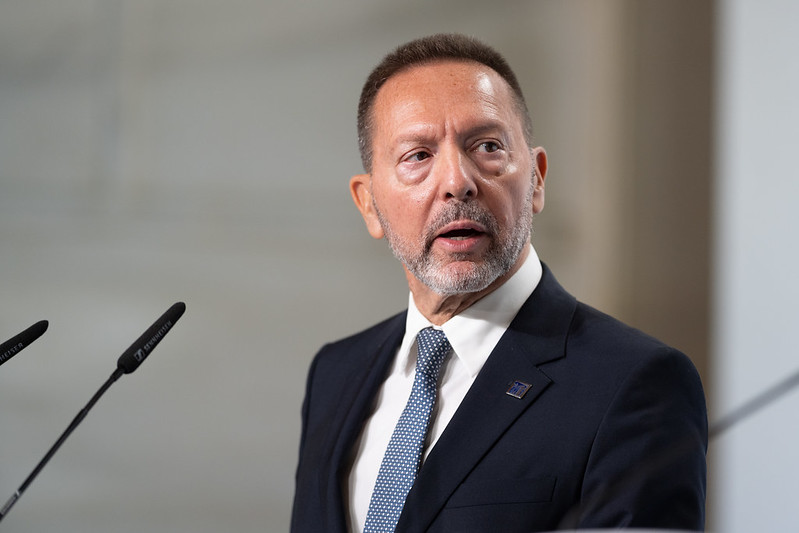
By David Barwick – FRANKFURT (Econostream) – European Central Bank Governing Council member Yannis Stournaras said Thursday that monetary policy would “continue to do whatever is needed to safeguard price stability,” while arguing that Europe’s longer-term economic prospects depend increasingly on structural reform and deeper integration.
The Bank of Greece governor made the comment in an opinion article published by Fortune Greece & Cyprus, in which he focused primarily on the structural challenges confronting the European economy.
“Monetary policy will continue to do whatever is needed to safeguard price stability,” Stournaras wrote.
He offered no more specific guidance in the article on the near-term interest-rate outlook or the timing of any further policy move.
Turning to the broader European economy, Stournaras said current international upheaval was not only a source of risk but also “a wake-up call for Europe,” underscoring the need to accelerate European integration and strengthen coordination of common policies.
In an increasingly fragmented and uncertain world, Europe’s prosperity and resilience needed to depend less on external conditions and more on its own capacity for innovation, investment and adjustment, he said.
Europe needed to close its investment gap with the United States in artificial intelligence while simultaneously improving the broader performance of its economy, according to Stournaras.
The underlying challenge was structural, he said, pointing to Europe’s persistent productivity underperformance relative to other major economies and demographic trends that were expected to reduce labor supply in coming years.
With a shrinking workforce increasingly unable to sustain economic growth, productivity would need to play a larger role, he wrote.
For much of the past 15 years, the euro area had relied on external demand and persistent current-account surpluses, while domestic demand as a share of GDP had fallen to among the lowest levels in advanced economies, according to Stournaras.
That growth model had worked for Europe for a time but had become increasingly vulnerable amid geoeconomic fragmentation and rising trade barriers, he said.
At the same time, Europe was exporting a substantial share of its savings, with around one-third of euro-area residents’ investment in listed equities currently concentrated in U.S. capital markets, a proportion comparable with their investment within the euro area itself.
While those investments generated financial returns for European savers, the productivity and innovation benefits accrued primarily to the countries in which the capital was invested, overwhelmingly the United States, Stournaras wrote.
Europe therefore urgently needed to channel more savings toward productive investment in common priorities including the green and digital transitions, energy security, defense capabilities and infrastructure, he said.
That required higher productivity and the removal of remaining barriers to cross-border trade in goods and services and to capital movements, including obstacles to cross-border bank mergers, Stournaras wrote.
He also backed common issuance of safe European debt, along the lines of the Recovery and Resilience Facility, to finance public goods such as defense, the green and digital transitions and energy security.
Completing the Savings and Investments Union was particularly important because it would improve capital allocation and provide growing European companies with financing they often currently lacked, Stournaras said.
A common European safe asset would also strengthen the European Union’s capacity to absorb common shocks, reduce fragmentation and finance shared priorities, he wrote.
Stournaras called as well for completion of Banking Union, saying establishment of a European Deposit Insurance Scheme according to a clear timetable would support cross-border banking activity and the free movement of capital and liquidity.
Sound public finances were meanwhile necessary to allow governments credibly to increase expenditure on defense, infrastructure and innovation without undermining public debt sustainability, he said.
Europe’s longer-term prosperity would increasingly depend on its ability to increase productivity, deepen the Single Market, complete Banking Union and the Savings and Investments Union, mobilize private capital and strengthen economic resilience, Stournaras wrote.
More than two years after publication of the Draghi and Letta reports, “the time has come to intensify our efforts for the future,” he said.